

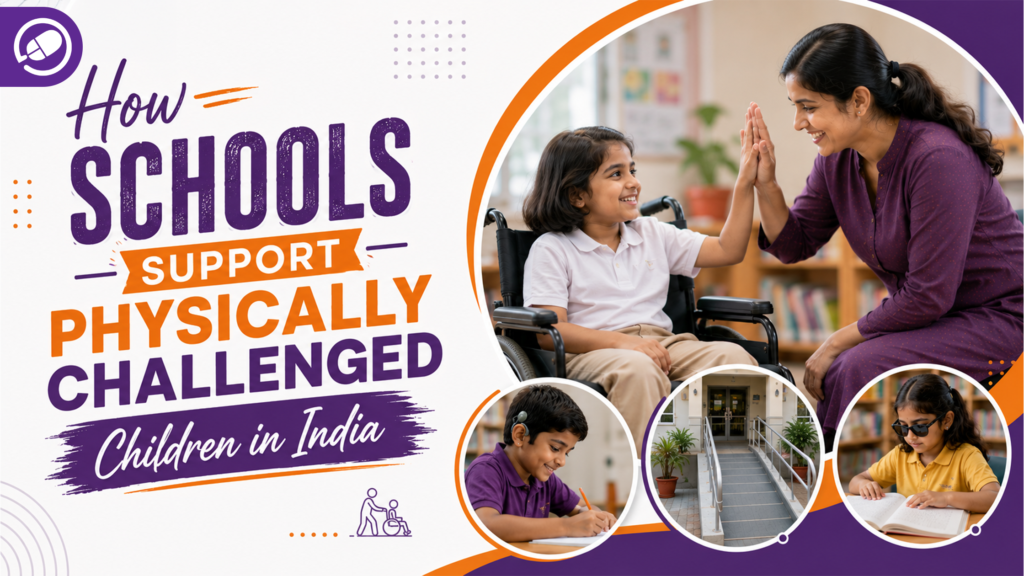
What Does "Physically Challenged" Actually Mean?
“Physically challenged” describes a child whose mobility or physical function is limited by a condition such as a locomotor disability, cerebral palsy, or a lasting injury, and who needs some form of physical or structural accommodation to learn on equal footing with peers. It isn’t a single diagnosis it’s an umbrella term.
You’ll also hear it used interchangeably with “physically disabled” or “physically handicapped” in India. All three point to roughly the same set of everyday needs: getting into the building, moving around it, and keeping pace with a normal school day without extra strain.
If your child falls into this group, Indian law has specific things to say about what a school owes them. Most parents just haven’t seen those provisions laid out plainly.
What Indian Law Actually Requires (RPWD Act 2016 & IEDSS)

India’s core disability law is the Rights of Persons with Disabilities Act, 2016 (RPWD Act), administered by the Department of Empowerment of Persons with Disabilities. Under the Act, every child with a benchmark disability between the ages of 6 and 18 has a right to free education, and government-funded or government-recognised institutions are required to provide inclusive education, not simply admit the child and leave the rest to the family.
Alongside the RPWD Act, the IEDSS scheme (Inclusive Education for Disadvantaged Students at the Secondary Stage) supports things like assistive devices, escort allowances, and resource-teacher support for students with disabilities at the secondary level.
The National Education Policy 2020 takes this further, treating inclusive education as a core policy goal rather than an add-on. It’s worth reading if you want the fuller picture of where Indian schooling is meant to be heading.
None of this guarantees a school gets it right in practice. But it does mean you’re not asking for a favour when you raise these needs you’re asking a school to meet an existing obligation.
Knowing your rights is one thing. Knowing what to actually look for in a school is another.
What Real Accessibility Support Looks Like
Real accessibility support isn’t one single feature it shows up in three places: whether your child can physically move through the building, whether the school’s pacing bends around medical needs, and whether your child actually feels included, not just present.
| Support Area | What It Should Include | Why It Matters |
|---|---|---|
| Physical infrastructure | Ramps at every entry point, accessible washrooms, elevator or ground-floor classroom placement | Determines whether your child can move through a normal school day without help at every step |
| Teaching & pacing support | Flexible attendance for therapy or medical appointments, recorded lessons, extended time where needed | Prevents your child from falling behind for reasons that have nothing to do with ability |
| Emotional & social inclusion | Peer-inclusion practices, trained staff, activities adapted rather than skipped | Academic access means little if your child is still left out socially |
Physical infrastructure
This is usually the first thing on a parent’s mind: can my child get from the classroom to the washroom, or up to the science lab, without needing help at every step? A ramp at the main gate is a good sign, but it isn’t the whole answer ask what happens once your child is actually inside the building.
Teaching & pacing support
A lot of parents ask a version of the same question: what happens when a physiotherapy session clashes with school hours, or a flare-up means missing a week? That’s usually the real test of a school’s flexibility not the prospectus, but whether a missed class turns into a genuine setback or just gets picked up later.
Emotional & social inclusion
Parents often worry less about the syllabus and more about whether their child will actually be included invited on the class trip, picked for the group project, not just seated at the back during sports period. Ask a school directly how they handle this, and notice whether the answer is specific or vague.
Where Traditional Schools Commonly Fall Short

The gaps are usually specific, not vague. Multi-storey buildings without a working lift. Daily schedules that don’t bend for a physiotherapy appointment or a hospital visit. Group activities and sports periods designed with no adapted version, so a child sits out instead of participating. Peer exclusion that no one names directly but that a child feels every day.
To be fair, physical infrastructure has genuinely improved in many urban schools over the past decade. The harder, less visible gap now is pacing and staff training a school can have a ramp and still not know how to adjust a test schedule around a medical appointment.
For many families, that gap in day-to-day flexibility not the ramps ends up being the real reason they start looking at other options.
7 Questions Parents Should Ask Before Choosing a School

A school’s website will always sound reassuring. These are the questions that actually tell you something:
- Is there step-free access to every classroom and facility my child will actually use not just the ground floor?
- Are the washrooms genuinely accessible, or just labelled as such?
- How does the school handle days when therapy or a medical appointment overlaps with school hours?
- If my child misses a week of classes, is there a way to catch up, or does the material simply move on without them?
- Have teachers actually been trained to work with a child who has a physical disability, or is it left to individual goodwill?
- Can my child take part in sports, trips, and group activities in some adapted form, or are they usually left out?
- What’s the plan if there’s a medical emergency during school hours?
If a school can answer these clearly and specifically, that tells you more than any brochure will.
How Cyboard School Supports Physically Challenged Students

By the time parents reach this stage, the real question usually isn’t whether a school means well it’s whether a missed class because of a hospital visit actually gets made up, or just gets lost. For some children with physical disabilities, an online, self-paced model answers that directly.
Cyboard School is NIOS-affiliated and IAO-accredited, and classes run on a self-paced learning management system with both live and recorded sessions. In practice, that means a child who misses a class for a therapy appointment or a flare-up can go back and watch it, rather than simply falling behind while the rest of the class moves on.
The NIOS board structure also means exams aren’t built around a single rigid attempt, which matters for families managing ongoing treatment alongside schooling.
This isn’t the right fit for every family a child who thrives on in-person peer interaction may miss that in a virtual classroom. But for a child whose main daily struggle is physical getting into the building, working around a fixed timetable, sitting out of activities removing that barrier can matter more than most other choices a parent makes. Inspiring Abilities goes into this in more depth for students with physical disabilities specifically, and the admission process page covers what applying actually involves.
Frequently Asked Questions
What does "physically challenged" mean?
What facilities help physically challenged children in school?
Is online school better for a physically disabled child?
What does Indian law require schools to provide for disabled students?
How does Cyboard support students with mobility needs?
Explore More on Cyboard School
This is a great article highlighting the challenges faced by individuals with physical disabilities. Access to quality physically challenged care services is essential, and having reliable disability care services in Chennai can make a huge difference in improving their quality of life.
Thank you for your thoughtful comment. We’re glad you enjoyed the article. We appreciate your support in raising awareness on this important issue.