
Last Updated: November 2026
Most parents who search for homeschooling in India end up asking the same three questions: Is it legal? How will my child take board exams? And what about friends?
This guide answers them in plain language. It explains what homeschooling is, how it works in India, which exam routes homeschooled students use, and how to decide whether it suits your child and your family. It also shows where online school fits in, for parents who like the idea of learning at home but do not want to be the only teacher.
What Is Homeschooling?
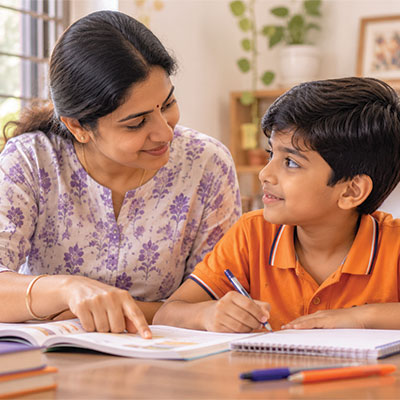
Homeschooling is an approach where parents take direct responsibility for their child’s education instead of enrolling them in a regular school. The family chooses the curriculum, sets the daily rhythm and decides how progress is checked. Learning can happen at home, in libraries, in sports clubs, in online courses and in the community.
So what is homeschooling in India in practice? Most families are not trying to avoid education. They are looking for something a local school may not offer: time for a serious sport or art, a calmer pace, support for a child with a health condition or learning difference, or stability for a family that moves often.
Homeschooling, Unschooling and Online School: What Is the Difference?
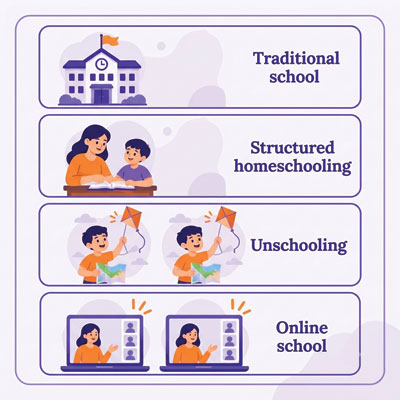
Understanding the distinctions between different alternative education models helps families select the right fit:
| Model | Who teaches | Curriculum | Board exams |
|---|---|---|---|
| Traditional school | School teachers | The school's board syllabus | Through the school |
| Structured homeschooling | Parents, sometimes with tutors | Chosen by the family, such as NIOS, Cambridge or NCERT-based study | As an open or private candidate |
| Unschooling | The child leads, with parent support | No fixed curriculum | The family needs a plan if the child wants Class 10 and 12 certificates |
| Online school | Teachers in live classes | The school's curriculum | Depends on the school, so ask which board conducts Class 10 and 12 |
Is Homeschooling Legal in India?
The most common fear among Indian parents is whether educating a child outside a registered school violates national education laws. To understand the legal reality, parents must examine three interconnected legal pillars: the Indian Constitution, the Right to Education Act, and formal government clarifications.
1. Article 21A of the Indian Constitution
The 86th Constitutional Amendment introduced Article 21A, which guarantees the fundamental right to free and compulsory education for all children between the ages of 6 and 14. This constitutional guarantee places a duty on the State to ensure access to education, but it does not mandate that this education must occur exclusively within a physical school building.
2. The Right to Education (RTE) Act, 2009
Much of the confusion surrounding the legality of home education stems from Section 18 of the RTE Act. Section 18 states that no school can be established or function without obtaining a formal certificate of recognition from the prescribed educational authority.
However, legal experts and statutory authorities point out that Section 18 is an institutional regulation designed to prevent unauthorized commercial operators from running sub-standard physical schools. It does not apply to parents educating their own children domestically. The RTE Act aims to protect children from being deprived of education, not to criminalize parents who provide dedicated individual instruction at home.
Our guide on whether homeschooling is legal in India covers this in more detail. This is general information, not legal advice.
How Does Homeschooling Work in India?
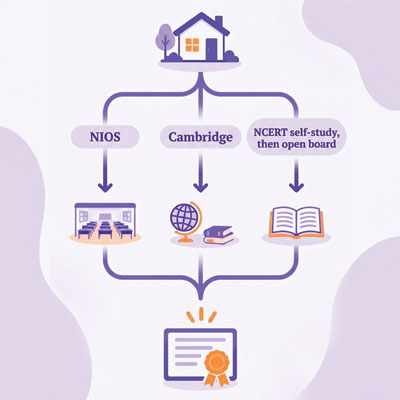
How does homeschooling work day to day? A family chooses what to study, how to study it and how progress is checked. Because a homeschooled child does not belong to a school, the board certificate comes from an open board or an international board. Here are the three common routes.
1. NIOS
The National Institute of Open Schooling is an autonomous institution established by the Ministry of Education, Government of India. It represents the primary, most accessible board pathway for Indian homeschoolers. To examine registration steps, subjects, and study materials, explore our detailed National Institute of Open Schooling guide.
- Open Basic Education (OBE): Covers foundational learning equivalent to standard elementary grades, divided into Level A (Classes 1 to 3), Level B (Classes 4 and 5), and Level C (Classes 6 to 8).
- Secondary Course (Class 10): Equivalent to standard 10th board examinations. Students choose from a wide range of academic and vocational subjects with complete examination flexibility.
- Senior Secondary Course (Class 12): Equivalent to Class 12 board certifications across science, commerce, and humanities streams, recognized by all Indian universities and competitive exam authorities.
2. Cambridge International
Families who want an international curriculum often choose Cambridge IGCSE, usually around Class 10, and A Levels, around Class 12. Private candidates register through an approved exam centre, so check which centres near you accept them and how science practicals are handled for private candidates.
3. NCERT-based Self-Study
Some families follow NCERT textbooks, which are publicly available, for Classes 1 to 8, and then register with an open board for Class 10. This keeps the early years flexible while still leading towards a certificate.
Designing a Daily Homeschool Routine
One of the greatest advantages of home-based education is time efficiency. In a traditional physical school, a 7-hour school day typically includes only 2 to 3 hours of direct, individualized academic learning. The rest of the time is consumed by morning assemblies, classroom transitions, teacher administrative tasks, peer disruptions, and lunch breaks.
At home, a focused 3-4 hour academic block easily covers the equivalent of a full institutional school day. A healthy daily rhythm for an Indian homeschool typically looks like this:
- Morning Block (9:00 AM to 11:30 AM): Core conceptual subjects requiring high mental energy, such as Mathematics, Language Arts, and Science problem-solving.
- Midday Break (11:30 AM to 1:00 PM): Physical movement, wholesome nutrition, household chores, and independent reading away from all screens. Parents can support this balance by establishing balanced screen time habits that protect growing eyes and emotional focus.
- Afternoon Block (1:00 PM to 2:30 PM): Exploratory and applied learning, including Social Studies research, creative writing, foreign language practice, or hands-on science experiments.
- Late Afternoon and Evening (3:30 PM to 6:30 PM): Structured external socialization, sports coaching, music lessons, community clubs, and free outdoor play with neighborhood peers.
This flexible rhythm allows children to pursue intense extracurricular passions like competitive tennis, classical music, coding, or chess without falling behind academically.
Board Exams, Colleges and Entrance Exams
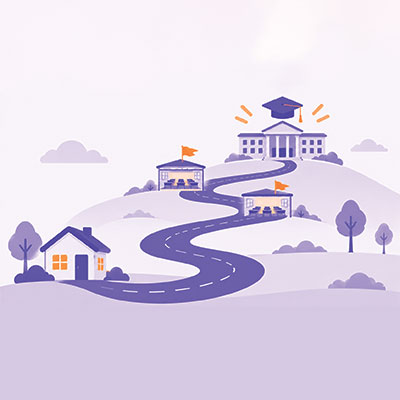
Homeschooled students earn their Class 10 and 12 certificates through an open board such as NIOS or an international board such as Cambridge. NIOS states that its certificates are recognised for higher education and jobs, but every course and employer still sets its own conditions.
Entrance exams such as JEE, NEET and CUET also set their own eligibility rules. These can cover the subjects studied, minimum marks and the type of Class 12 certificate. Before choosing subjects in Class 11, read the latest information bulletin of each exam your child may take. For universities abroad, check each university’s requirements for Indian board certificates.
The Challenges Parents Talk About
Homeschooling takes real time and energy, and it helps to know the hard parts before you start.
The Parent Workload
A homeschooling parent is the teacher, the planner and the administrator at once. Balancing this with a job or a household can lead to exhaustion, especially in the first year. Our homeschooling tips for busy parents share practical ways to plan the week.
The Subject Hurdle in Higher Classes
Teaching reading and basic numeracy in early classes is manageable for many parents. In Classes 8 to 12, subjects such as advanced maths, physics and chemistry get specialised, and families often pay for tutors or online courses.
Planning a Social Life
At school, friendships happen by default. At home, you have to build them through sports classes, clubs, community projects and play dates.
Is Homeschooling Right for Your Family?
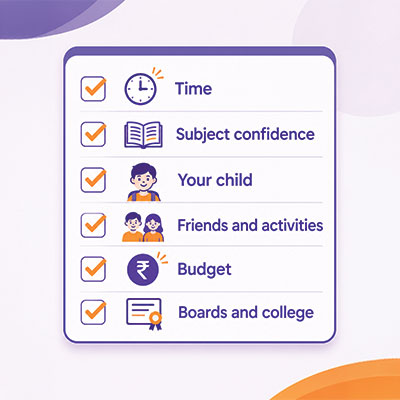
Talk through these questions together before you decide:
- Time: Can at least one parent give several focused hours each day to planning, teaching and reviewing?
- Subject confidence: Can you teach, or arrange teaching for, the higher classes?
- Your child: Will they stay motivated without a class around them?
- Friends and activities: Are there clubs, sports or groups nearby?
- Budget: Have you counted books, tutors, lab or practical sessions, activities and exam fees?
- Boards and college: Have you chosen a board route and checked subject needs for the course your child may want?
If you like the idea of learning at home but do not want to be the only teacher, an online school is another option.
Learning at Home Without Being the Only Teacher
Some families want the flexibility of home learning without planning every lesson. Cyboard School is a 100% online school with live classes taught by subject teachers, regular assessments, and clubs and activities. Its Class 10 and 12 exams are conducted through NIOS. It is accredited by the International Accreditation Organization (IAO), which is a quality review and not a board certificate.
If you’re weighing homeschooling against structured online schooling options, Cyboard School gives you the flexibility to bring your kid’s school home along with a structured daily routine and a CBSE-aligned curriculum so that your child doesn’t lag behind. To get all your questions answered, book a free counselling session today.
Conclusion
Homeschooling means a family takes charge of how a child learns, and in India that comes with three things to plan: how the law applies in your state, which board route will give your child a certificate, and how you will share the workload. None of them is a reason to avoid it. Each one is a reason to decide with your eyes open.
Check the rules that apply to you, talk to families who have done it, and start small. If you want learning from home with more support, compare structured online schools as well.
Frequently Asked Questions on Homeschooling
Is homeschooling legal in India?
Can homeschooled students appear for Class 10 and 12 board exams?
How do homeschooled children do science practicals?
What is the difference between homeschooling and online schooling?
Can a homeschooled child return to a regular school?
How much does homeschooling cost in India?
Sources
- Right of Children to Free and Compulsory Education Act, 2009: sections 4, 5 and 10, with the Ministry of Education’s section-wise note.
- National Institute of Open Schooling official guidelines and prospectus.
- Delhi High Court 2011 petition and the Ministry’s affidavit regarding homeschooling recognition.