

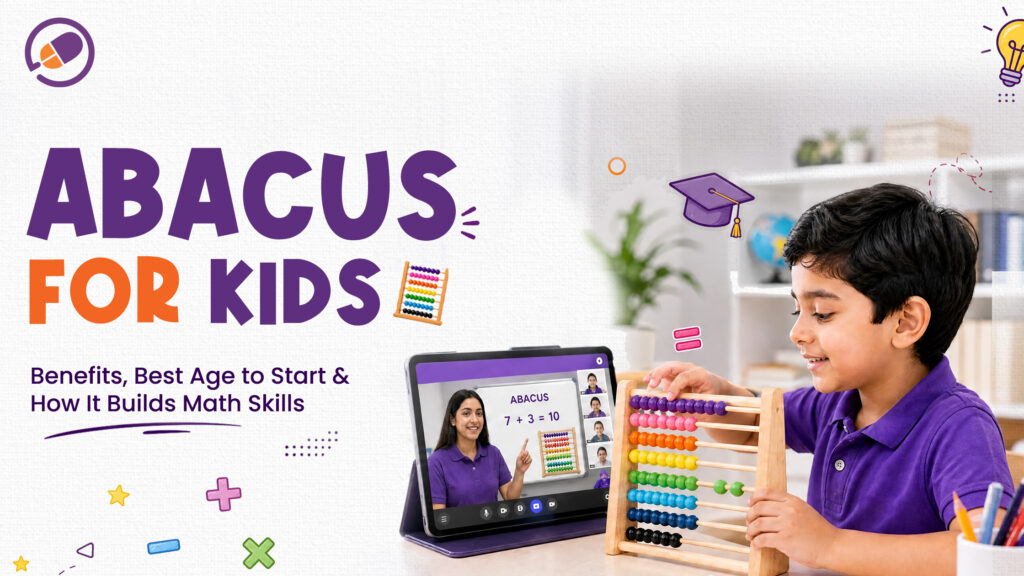
You have seen it happen. Your child sits down with maths homework, stares at the page, and calls you over with that look, the one that says they just want it to be over.
It is not a discipline problem. It is not a motivation problem.
It is a foundation problem. Most children hit a wall because maths switches from something physical and countable to something completely invisible. Nobody gives them the right bridge. Abacus for kids is that bridge.
Quick Takeaways • Best age to start: 5–8 years (children up to 14 benefit too) • Daily practice needed: 10–15 minutes is enough • Main benefit: mental math + working memory across all subjects • Mental abacus timeline: 12–18 months of regular practice |
Why So Many Children Struggle with Maths, and What the Abacus Actually Does About It

The problem is not intelligence. For most children, the real difficulty is the jump from counting physical objects to working with numbers that exist only as abstract symbols.
Children do not fear maths first. They fear confusion.
A child who feels confused repeatedly eventually stops trying.
Up to 10, a child can count on fingers and toes. Beyond that, numbers become invisible and young brains are not naturally wired for abstraction. Abacus fixes this by making numbers physical again. Each bead has a position and a value. Place value is not a concept to memorize — it is something a child can see, touch, and move.
India-Specific Reality Most Indian parents have been through this cycle: tutors hired, coaching classes attended, extra worksheets given and yet the same gaps reappear in class tests. The reason is that traditional maths teaching targets the syllabus, not the foundation. Rote tables and drill practice build memory. They do not build number sense. Abacus works at the root level, before the syllabus even matters. |
What Happens in Your Child's Brain During Abacus Practice

Most school maths relies heavily on step-by-step memorisation. The abacus adds a different visualisation.
Instead of only memorising steps, children begin visualising numbers and relationships between them. When a child tracks bead positions during a calculation, they are not just counting. They are building a mental map of where numbers live.
The practical result: faster recall, less finger-counting, and the ability to hold multiple values in mind without dropping one. These are not abstract improvements. Parents notice them within a few months.
A 2018 study published in Frontiers in Psychology found that abacus-trained children significantly outperformed their peers in working memory, mental calculation speed, and sustained attention and the gains extended beyond maths into other academic tasks.
What Is Mental Abacus And Why It's the Real Goal
Most parents think the goal of abacus training is to use the physical frame faster. It is not.
The frame is the training wheel. Over time, children stop depending on the physical frame altogether. Many eventually begin visualising bead movements mentally during calculations. This is why many abacus-trained children can solve multi-digit problems mentally much faster than expected.
This transition typically takes 12–18 months of consistent practice. Children do not arrive there in one step. They move through levels of the physical frame, build confidence with increasingly complex sums, and gradually internalise the bead positions until the tool becomes unnecessary. Most parents who pull their children out of abacus programs early do so just before this stage, which is when the most impressive gains arrive.
Real Benefits of Abacus Learning for Children

1. Mental Math Without Paper
Abacus does not teach children to calculate faster. It teaches them to calculate differently using spatial memory instead of verbal rehearsal.
Picture a Class 3 student facing 347 + 289 in a mental maths test. An untrained child attempts to carry numbers verbally — 7 plus 9 is 16, carry the 1 — and usually loses a value mid-process. An abacus-trained child visualizes bead columns shifting and reports the answer in under 10 seconds, without writing a digit. The difference is not speed training. It is a different mental model for what arithmetic is.
2. Stronger Working Memory Across Every Subject
Working memory is the brain’s temporary workspace where active thinking happens. Abacus practice systematically expands it.
The same capacity that holds bead positions during a calculation is what a child uses to track an argument while reading, retain the steps of a science experiment, or hold the beginning of a sentence while writing the end.
Parents with children in abacus programs for 6–12 months consistently report improved retention across subjects – not just maths.
Abacus changes how children think about numbers not just how quickly they answer.
3. Concentration That Carries Into Other Subjects
A single abacus calculation requires holding multiple values in mind while executing precise physical movements. That is a concentration demand most classroom tasks never match.
After 3–4 months of consistent practice, the effects show up elsewhere. Children who previously drifted mid-task become noticeably more able to stay with a problem until it resolves. Sustained attention practiced daily becomes a transferable habit.
4. Deep Place Value Understanding
Place value is the silent failure point in Indian school maths. A child can recite that the 5 in 536 means 500, and still make systematic errors in subtraction with borrowing, or fall apart entirely when decimals appear in Class 4.
The abacus rod structure makes place value unambiguous. Units, tens, hundreds, and thousands each occupy a different physical rod. Children who learn place value this way visually and spatially, develop a mental model strong enough to handle fractions and decimals without the conceptual reset most students need.
5. Confidence With Numbers
A child who falls behind in Class 2 arithmetic approaches Class 3 multiplication already behind and already afraid. Abacus interrupts that cycle by rebuilding the relationship with numbers from a position of competence not remediation.
India’s national and state abacus competitions offer concrete social proof. The children who compete are not the naturally gifted ones. They are children whose confidence was rebuilt through structured, progressive practice. That confidence generalizes into the classroom.
6. Fine Motor Development (Ages 4–7)
For children in the 4–7 age range specifically, the precise bead movements of abacus practice deliver real motor development. Deliberate, controlled finger movements require hand-eye coordination well beyond what most daily activities demand at that age.
The same control that places beads accurately steadies handwriting, sharpens drawing, and makes keyboard use more confident. For younger children, abacus is doing double duty and parents rarely realize it.
What Age Should Your Child Start Abacus A Practical Guide
Direct Answer: The ideal age to start abacus in India is between 5 and 8 years, though children up to 14 can benefit significantly. The earlier window builds foundational number sense; the later window develops speed and accuracy.
| Age Group | Stage | Readiness | What Abacus Develops |
|---|---|---|---|
|
4–5 years |
Foundation |
Early |
Number recognition, counting, fine motor skills |
|
5–8 years |
Core Learning |
Optimal |
Mental math, place value, concentration |
|
8–12 years |
Acceleration |
Strong |
Speed, accuracy, mental abacus mastery |
|
12–14 years |
Advanced |
Good |
Complex calculations, competition-level performance |
Signs your child is ready: They can count to 20 reliably, recognize numbers on sight, and follow a two-step instruction without needing it repeated. Those three things are sufficient no other prerequisites.
Starting earlier helps, but consistency matters more than age.
Some children progress faster than others, but consistency matters far more than speed.
A 10-year-old who practices 10 minutes every day will outperform a 5-year-old who attends weekly classes and does nothing in between.
India Note
Many CBSE schools include abacus as a math lab activity from Classes 1–3, which maps directly onto the 5–8 optimal window. If your child’s school already offers it, treating it as a serious daily practice rather than just a classroom activity makes a substantial difference to the outcomes.
Abacus vs Calculator Which Is Actually Better for Your Child?
Direct Answer: For children, abacus is better than a calculator for learning — not because calculators are bad, but because abacus builds number sense that a calculator assumes you already have.
| Dimension | Abacus | Calculator |
|---|---|---|
|
Builds number sense |
Yes |
No |
|
Develops mental math |
Yes |
No |
|
Requires active thinking |
Yes |
Bypasses it |
|
Good for learning maths |
Ideal for learning |
For checking answers only |
|
Good for professionals |
Not the goal |
Yes |
Calculators solve problems for children. Abacus teaches children how numbers behave.
Calculators are useful once children already understand number relationships. Abacus helps build that understanding first. Given to a child still building number sense, it skips the entire learning process.
What to Look for in an Online Abacus Class (For Indian Parents)

The quality difference between abacus programs is significant. A strong program produces measurable gains in 3–6 months. A weak one produces a child who can move beads but cannot calculate. Five things worth checking before you enroll:
- Structured level progression — Look for 6–10 defined levels with clear assessment at each transition. No defined levels means no accountability and no way to measure genuine progress.
- Practice accountability — Any program worth its fees insists on 10–15 minutes of daily home practice. If the instructor tells you the weekly class is sufficient, that is a red flag. The class builds technique. Daily practice builds the mental model.
- Batch size — Small batches of 5–8 children allow the instructor to correct individual technique, which matters most in the early levels. Large group classes are significantly less effective for this skill.
- Transition to mental abacus — Ask directly: ‘When and how do you move children away from the physical frame?’ A vague answer means the program has no defined pedagogy for the most important stage of the process.
- Parent visibility — Good programs provide regular progress updates, level completion reports, and practice sheets. A good instructor should be able to explain your child’s progress in plain language, not just level numbers. Parents should clearly understand what their child is improving at not just which level they completed.
Cyboard School includes abacus as part of its structured math lab program with level-based progression and parent reporting built into the curriculum. Explore the full math curriculum at Cyboard’s school curriculum page.
Is Abacus Worth It?

Yes – with one honest qualifier. It works when a child practices for 10–15 minutes every day and stays with it past the 6-month mark. Parents who treat it as a drop-in enrichment activity often pull back just before the real gains arrive. Parents who treat it as a foundational investment, in the same category as learning to read, almost always see a different child by the end of the year.
Children rarely become confident in maths because they are forced to practice more. Confidence usually comes after numbers finally start making sense.
If you are looking for a structured online learning environment that includes abacus as part of a broader curriculum rather than as a standalone add-on, Cyboard’s online homeschooling program is worth exploring.
FAQ Your Questions About Abacus, Answered
What is abacus and how does it work?
What age should a child start abacus?
How does abacus help a child's brain development?
How long does it take to learn abacus?
Can children learn abacus online?
Is abacus only for children who are weak in maths?
How many minutes a day should a child practice?
Does abacus help with CBSE maths?
Explore More on Cyboard School
Heartfelt Appreciation for Your Outstanding Support
Dear Harshita Daksh,
I am writing to express my sincere gratitude for the exceptional support and guidance you have provided my daughter, Swara, during her admission process.
Your dedication and hard work have truly made a significant impact on us. Your honesty, intelligence, and customer-centric approach were evident in every interaction we had. It was clear that you were always willing to go the extra mile to ensure that Swara had the best possible experience.
Your professionalism and beautiful spirit shone through in all our communications, making what could have been a stressful process much more manageable and pleasant. We are immensely grateful for your unwavering support and commitment to your work.
Thank you once again for everything you have done for Swara and our family. Your efforts have not gone unnoticed, and we are truly appreciative of your exceptional service.
Warm regards,
Ganesh
We are extremely thankful that our admission counselor, Harshita, has received such immense praise for her dedication and support. Thank you so much for recognizing her efforts and sharing your positive experience.