

The world is changing too fast, isn’t it? Even education today doesn’t look or sound the same as it used to.
From “pack my lunch box”, “iron my uniform”, “where are my shoes, socks, school tie?”, “Where is my history book? I have a class today,” To “did we pay the WiFi bill?” “I can’t miss my online class.”
Everything has shifted.
But here’s the question no body is dare to ask, does just turning on a phone or laptop camera actually make learning useful in an online school?
What about how you present yourself when students from across the world can see you? What about being part of a real learning environment, even if it’s digital?
Online class etiquette is something that should be taught before joining an online class. Because yes, the morning rush is gone, but does that mean sitting in front of a camera with constant background noise, eating during live classes, or treating it casually is okay?
No, right?
We are changing the way we study to make education more accessible, not to take away the respect it deserves.
What Does Online Class Etiquette Mean?

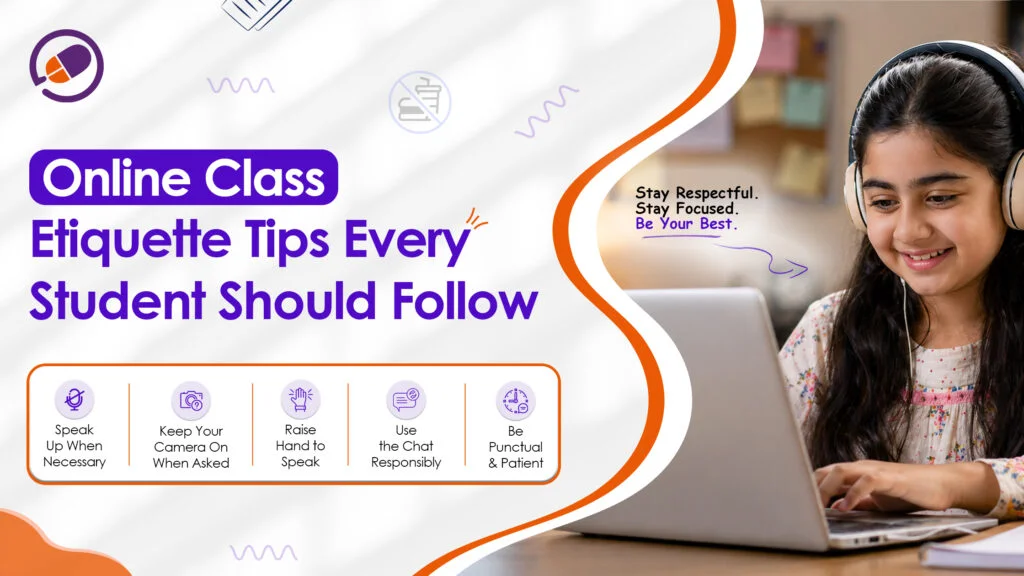
Online class etiquette is simply how you behave in a virtual classroom, the unwritten rules that make a live session respectful, productive, and comfortable for everyone sharing that digital space.
Think of it as the online version of physical classroom manners. When you walked into school, you automatically followed certain norms. You didn’t shout over the teacher. You raised your hand before speaking. You paid attention. It covers the small but significant habits that shape every session.
A dark or silhouetted face makes it impossible for an instructor to read the room, and it signals a certain carelessness about being present.
Underneath all of these habits lives something deeper, self-discipline in online learning. In a physical school, the environment enforces focus. Online, that structure disappears. No one is watching whether your phone is face down. No one notices the other tab open on your browser. Self-discipline in online learning means you create that structure yourself. You show up intentionally, you stay present, and you hold yourself to the same standard you would in a room full of people.
Here are a few simple ways that can help you build better online class etiquette:
1. Create a Distraction-Free Learning Space
One of the most overlooked aspects of online class etiquette is where you sit, not just how you behave. A noisy kitchen, a living room with the television on, or a shared space full of background chatter makes it nearly impossible to focus and even harder for others to hear you when you speak. Choose a quiet corner to set up your study space, close the door if possible, and let people around you know you are in class.
2. Dress Appropriately for Online Classes
You may not be wearing a uniform anymore, but that doesn’t mean anything goes. Dressing appropriately for an online class shows respect for your teacher and classmates, and helps you shift into a focused learning mindset instead of staying relaxed or distracted.
It also affects how you feel. When you’re presentable, you’re naturally more alert and engaged. You don’t need to be formal, just neat and ready, because on camera, you’re part of a classroom that can span cities or even countries.
3. Respect Others
Respect in a virtual classroom looks a little different from a physical one, but it matters just as much. It means not talking over your classmates, not making dismissive comments in the chat, and not reacting to someone’s question with ridicule, even silently.
It means keeping your microphone considerate, because muting yourself when not speaking is one of the most direct ways to show respect for everyone else in the session. It means treating your instructor’s time and preparation as something valuable.
4. Be Punctual & Patient
Joining a live session 5 minutes late is not just an inconvenience for you. It interrupts the instructor mid-flow, distracts classmates, and costs everyone a moment of focus that is hard to recover. Log in early, test your audio, check your connection, and be ready before the session begins. Patience matters just as much. Technology has bad days. Instructors stumble over words. Classmates take longer to understand something. Waiting for your turn to speak, without sighing, without typing impatiently in the chat, without unmuting to rush someone along, is a mark of genuine maturity in an online learning environment.
5. Speak Up When Necessary
Online class learning is not about staying silent. It is about speaking at the right moment, in the right way. If you have a question, ask it. If something is unclear, say so. If you have a contribution that adds to the discussion, make it. The key is waiting for your turn to speak so that the conversation stays orderly and everyone gets heard. Use the raise hand feature, wait to be acknowledged, and then unmute and speak clearly. A virtual classroom where only the instructor speaks is a lecture, not a class.
6. No Food During The Class
This one seems minor until you have been on the receiving end of it. The sound of chewing, the rustle of a packet, the clinking of a spoon in a bowl, all of it travels clearly through a live microphone and lands directly in everyone else’s ears. Even with your mic muted, eating on camera is visually distracting and signals that you are not fully present. Treat class time as class time, not lunch break time. Eat before, eat after, and keep your focus where it belongs.
7. Keep A Pen And A Notebook
Screens are full of distractions. A notification here, a tab there, and before long, you are reading something entirely unrelated to your class. Writing notes by hand keeps you anchored to the session. It forces you to listen actively, to process what is being said, and to translate it into your own words. It is one of the simplest and most effective tools for self-discipline in online learning. A pen and a notebook also serve a practical purpose. When your internet drops for thirty seconds or a classmate’s audio cuts out, your notes fill in the gaps that technology leaves behind.
8. Use Appropriate Language
A virtual classroom is still a classroom. The fact that you are behind a screen does not change the standards of language that apply. Avoid slang that could offend, skip the sarcasm that does not land well in text, and never type something in the chat that you would not say out loud in front of your teacher. This applies to how you address your instructor, how you respond to classmates, and how you react when something goes wrong technically. Respectful language says you take the people in it seriously.
9. Check Your Tech Before Class
Nothing disrupts a session faster than someone spending the first 10 minutes troubleshooting a frozen screen or a microphone that will not work. Online class etiquette starts before the class does. Restart your device if needed, check your internet connection, update your platform, and test your audio and video at least 5 minutes before joining A quick pre-class check is one of the most practical habits because it shows you value everyone else’s time as much as your own.
10. Keep Your Camera On When Asked
A grid of black squares with names on them is not a classroom. It is a radio show. When your instructor asks students to keep cameras on, honour that request. Being visible creates accountability, builds connection, and makes the session feel like a shared experience rather than a broadcast. Make sure proper lighting for video calls is sorted so your face is clearly visible, your background is tidy, and you look like someone who is present and engaged, not someone who forgot they were on camera.
11. Use the Chat Responsibly
The chat box is a tool, not a side conversation. Use it to ask relevant questions, share links the instructor requests, or respond when asked. Avoid using it to have unrelated conversations with classmates mid-session, post jokes while someone is speaking, or flood it with messages that pull attention away from the lesson. Online class etiquette in the chat is the same as etiquette anywhere else, say something when it adds value and hold back when it does not.
12. Do Not Multitask
One of the quiet killers of self-discipline in online learning is the assumption that because no one can see your other screen, it does not count. It does. Replying to messages, watching videos, or working on something unrelated while your class runs in the background is not attending class. You are not absorbing what is being taught, you are not contributing meaningfully, and you are shortchanging yourself on the education you are paying for or working toward.
According to the National Library of Medicine, digital multitasking and frequent work interruptions are increasingly recognised as significant stressors in modern, technology-driven environments. Studies show that multitasking conditions are associated with higher perceived stress levels and measurable physiological stress responses, indicating that constantly switching between tasks can strain both mental and biological systems.
13. Follow Your Instructor's Guidelines
Every instructor runs their virtual classroom a little differently. Some prefer questions at the end. Some encourage open discussion. Some have strict rules about recording. Respecting those guidelines is a core part of online class etiquette. Read any instructions shared before the session, follow the format the instructor sets, and when in doubt, ask rather than assume. A student who adapts to the structure being offered learns more and disrupts less.
Coming To The End
Online class etiquette isn’t a checklist you follow once. It’s a habit you build over time, session by session, until it becomes second nature.
Simple actions like muting when not speaking, keeping your camera clear, waiting your turn, and staying disciplined may feel small, but they create a focused and respectful learning space for everyone.
They are small, consistent choices that add up to something meaningful, a virtual classroom where everyone can learn, contribute, and be heard.
The morning rush may be gone. The uniform is hanging unused. The lunchbox stays in the cupboard. But the responsibility of being a good student, a considerate classmate, and a respectful presence in a shared learning space? That has not gone anywhere. It has simply moved online.
Education became more accessible when it moved to a screen. The least we can do is show up to it with the same respect we would give a classroom.
Frequently Asked Questions (FAQs)
1. What is online class etiquette, and why does it matter?
2. Why is muting yourself when not speaking so important in online classes?
3. How does self-discipline in online learning differ from studying in a physical school?
4. What is the easiest way to improve proper lighting for video calls?
5. How can students practise waiting for their turn to speak in online classes?
Explore More on Cyboard School