

It is 7 am, and whether you are packing a school tiffin box or planning meals between online classes at home, you are trying to decide what to make that your child will actually eat and that is good for them too. Most Indian parents know this feeling.
A balanced diet chart for kids is built to take the guesswork out. This guide gives you a simple meal plan that follows the Dietary Guidelines from the Indian Council of Medical Research (ICMR-NIN), uses everyday foods from an Indian kitchen, and is organised by age, so you can see what your child needs at 4, at 10 or at 15.
Inside, you will find daily food group amounts, a 7-day meal plan, tiffin ideas, and tips for fussy eaters.
What is a Balanced Diet for Kids?
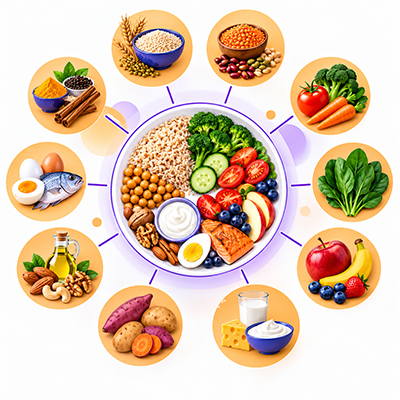
A balanced diet for kids is one that gives a child the nutrients needed to grow, learn, and stay active by eating a variety of foods from different food groups every day. No single food provides everything, which is why variety matters.
The ICMR-NIN Dietary Guidelines for Indians 2024 divide foods into ten groups: cereals and millets, pulses, vegetables, nuts, oil seeds and fats, green leafy vegetables, fruits, dairy, roots and tubers, flesh foods (fish, poultry, eggs and lean meat), and spices and herbs. They recommend eating from at least five to seven of these groups every day.
Physical activity matters too, because it helps the body make full use of the nutrients in food. The next section turns all this into amounts you can use.
Balanced Diet Chart: Food Groups by Age
The balanced diet chart for children below shows how much of each food group ICMR-NIN suggests across a whole day for normally growing kids. Amounts are raw weights, and milk is in millilitres. Treat it as a guide, not a rule, because needs change with a child’s weight and activity. Age bands follow ICMR, so 1 to 3 years means up to 3 years and 11 months.
Balanced diet chart for kids: suggested daily food groups by age
| Age Group | Cereals & Millets | Pulses | Green Leafy Vegetables | Other Vegetables | Fruit | Nuts | Milk or Curd | Oil & Fats |
|---|---|---|---|---|---|---|---|---|
| 1–3 years | 100 g | 50 g | 50 g | 100 g | 60–75 g | 10 g | 350 ml | 20 g |
| 4–6 years | 160 g | 60 g | 50 g | 100 g | 75 g | 15 g | 350 ml | 20 g |
| 7–9 years | 200 g | 65 g | 100 g | 150 g | 100 g | 20 g | 400 ml | 25 g |
| Boys 10–12 | 280 g | 90 g | 100 g | 200 g | 100 g | 30 g | 400 ml | 35 g |
| Girls 10–12 | 250 g | 85 g | 100 g | 200 g | 100 g | 30 g | 400 ml | 30 g |
| Boys 13–15 | 390 g | 130 g | 100 g | 200 g | 100 g | 40 g | 400 ml | 45 g |
| Girls 13–15 | 300 g | 100 g | 100 g | 200 g | 100 g | 35 g | 400 ml | 40 g |
| Boys 16–18 | 450 g | 150 g | 100 g | 200 g | 150 g | 50 g | 400 ml | 55 g |
| Girls 16–18 | 315 g | 105 g | 100 g | 200 g | 150 g | 40 g | 400 ml | 40 g |
Note: Values are presented as provided. Please refer to the original nutritional guidelines for serving definitions and age-specific requirements.
Roots and tubers, such as potato, carrot and sweet potato, add 50 g a day up to age 6, and 100 g a day from age 7.
A few simple rules sit behind these numbers:
- At least half of the cereals should be whole grains, such as whole wheat and millets. Up to the age of 10, about one-fifth of the raw cereals should be millets, such as ragi, bajra or jowar.
- Every meal should come with dal and vegetables.
- Non-vegetarian families can replace part of the pulses with eggs, fish or meat.
- Pair plant-based iron sources, such as dal and leafy vegetables, with vitamin C-rich foods like lemon, amla or guava.
- Encourage children to drink plain water regularly. Buttermilk and other suitable drinks can add variety, while packaged sugary drinks and fruit juices should not routinely replace water or whole fruit.
How Diet Changes With Age
Ages 3 to 6
ICMR advises that children under five need foods rich in energy, protein, vitamins and minerals that are not too bulky, such as dal, nuts, ghee or oil, milk and eggs. Offer vegetables, green leafy vegetables, and seasonal fruit every day.
A sample day for a 4 to 6-year-old includes whole grains, dal, vegetables and greens, curd, a little oil, fruit at the end of meals, and milk through the day. For young children, nuts are best powdered or finely chopped, as whole nuts can be a choking risk.
Ages 7 to 9
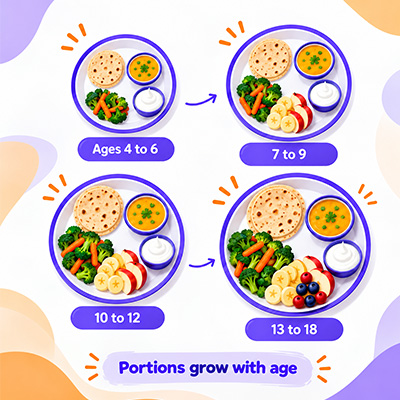
Portions grow with the child. Green leafy vegetables rise to 100 g a day, fruit to 100 g and milk or curd to 400 ml. Rotate different dals, millets and seasonal vegetables through the week so meals do not become repetitive.
Ages 10 to 12
The growth spurt starts around 10 to 12 for girls and about two years later for boys, so needs rise. Calcium becomes especially important. Good sources include milk and curd, ragi, foxtail millet, and sesame. From this age, the amounts differ slightly for boys and girls.
Ages 13 to 18
Teenagers need more of everything, especially protein foods and calcium for building strong bones. Dal, paneer, tofu, eggs, fish, chana, nuts and seeds all help. ICMR suggests eating seeds such as fenugreek, amaranth, flax, and chia three to four times a week, and limiting packaged foods high in oil, salt, and sugar.
This is also the age when food habits are shaped by friends and advertising, so involve teenagers in planning meals. Regular exercise matters alongside food, which is why balancing school with sports is worth planning.
Healthy Food Chart for Kids
Here is a sample diet chart for kids based on Indian dietary preferences. Adjust the portions above using the table mentioned in the previous section.
| Day | Breakfast | Lunch | Evening Snack | Dinner |
|---|---|---|---|---|
| Monday | Vegetable upma with peanuts, milk | Roti, dal, lauki sabzi, salad, curd | Fruit with roasted chana | Vegetable khichdi with curd |
| Tuesday | Ragi dosa with sambar | Rice, rajma, mixed vegetables, salad | Moong sprouts chaat | Roti, dal, palak sabzi |
| Wednesday | Moong dal cheela with mint chutney, fruit | Roti, chana dal, bhindi, curd | Curd with fruit and a few seeds | Vegetable pulao, dal, raita |
| Thursday | Idli with sambar, fruit | Bajra or jowar roti, dal, methi sabzi, curd | Roasted makhana or boiled corn | Vegetable daliya with dal |
| Friday | Stuffed vegetable paratha with curd | Rice, sambar, beans poriyal, buttermilk | Fruit chaat with seeds | Roti, dal, mixed sabzi, salad |
| Saturday | Poha with vegetables and peanuts, milk | Roti, lobia or chole, seasonal sabzi, curd | Whole-wheat vegetable and paneer sandwich | Roti, dal, gourd sabzi |
| Sunday | Vegetable uttapam with chutney | Rice or roti, dal, sabzi, salad, curd | Fruit and curd | Soft roti, dal, cooked vegetables |
Non-vegetarian families can add eggs at breakfast or as a snack, and use fish, chicken or egg curry in place of part of the pulses. Add seeds such as fenugreek, flax, or chia three to four times a week.
Healthy Tiffin and Snack Ideas
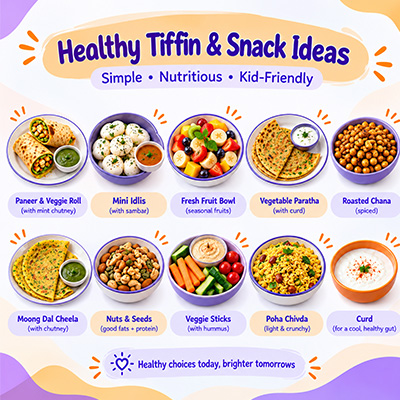
ICMR describes a healthy snack as vegetable or fruit salads with seeds or nuts and curd, or roasted or boiled beans, chickpeas and peanuts. Some of the healthy tiffin and snack ideas that follow the same idea are:
- Paneer or Egg and Vegetable Roll – Whole wheat roti filled with paneer or egg and vegetables.
- Methi Thepla with Curd – Methi Thepla served with plain curd.
- Peanut and Vegetable Poha – A vegetable-rich preparation with peanuts.
- Whole-Wheat Vegetable and Paneer Sandwich – Whole-wheat bread filled with paneer and chopped veggies.
- Curd Rice with Vegetables – Rice mixed with curd and finely chopped or cooked vegetables.
- Fruits with roasted makhana – Seasonal fruits, cucumber, and roasted chana or makhana.
For homeschooling parents
When a child studies from home, the kitchen is always close, so snacking can become constant. A few habits help:
- Make sure breakfast is eaten before the first class.
- Keep a water bottle and one planned snack at the desk, not open packets of chips or biscuits.
- Eat lunch away from the screen, and keep to regular times that fit the timetable.
- Use screen time rules that include screen-free meals.
How to Handle a Fussy Eater
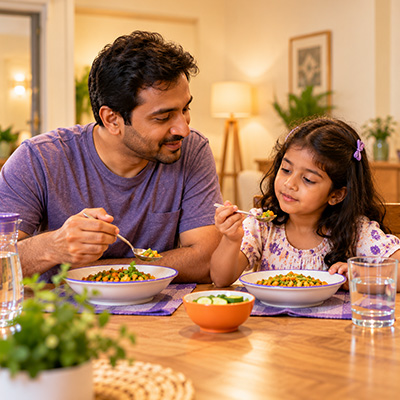
Almost every parent faces this at some point. A few approaches usually help:
- Offer new foods in small portions next to a favourite, and keep offering them without pressure.
- Never force-feed. Serve a balanced plate and let your child decide how much to eat, and keep mealtimes calm.
- Leave a gap before meals. Avoid snacks and sweet drinks close to mealtime.
- Let your child help. Washing vegetables, choosing fruit, and making simple fireless cooking recipes for kids make children more curious about food.
- Blend vegetables into familiar dishes such as cheela, paratha or khichdi.
- Eat together. This keeps screens away during meals.
What to Limit in Your Child’s Diet?
ICMR advises keeping added sugar below 5% of daily energy, and avoiding packaged foods that are high in oil, salt, or sugar. In practice, that means limiting biscuits, chips, frozen foods, sweetened beverages, and bakery products.
Conclusion: Balanced Meals Are Built One Plate at a Time
A balanced diet chart for kids does not need to be complicated. It needs to be simple enough to follow and flexible enough to adapt. The goal is to give your child a little of everything throughout the week. Start with daily food groups, add a vegetable and dal to every meal, and use the 7-day plan as the starting point.
That said, it is important to note that no guide replaces your child’s own appetite and your paediatrician’s advice. Speak to a registered dietitian if you notice:
- Slow gain in height or weight
- Persistent tiredness and low energy levels
- Frequent illness
- Refusal of whole food groups for a long period of time
- Signs of an allergic reaction after certain foods
To conclude, healthy eating is easier when the day has a rhythm. This starts with a perfect morning routine for students. What matters throughout the day is to leave enough time for breakfast, lunch and dinner together as a family. Cyboard School believes that learning goes beyond textbooks, and that good habits at home support good learning at school.
This guide is general information and not a substitute for medical advice
Frequently Asked Questions on Balanced Diet Chart for Kids
What is a balanced diet chart for kids?
What can I pack in my child’s tiffin?
How can vegetarian kids get enough protein?
What should I do if my child is a fussy eater?
Should I put my child on a diet chart to lose weight?
Explore More on Cyboard School