

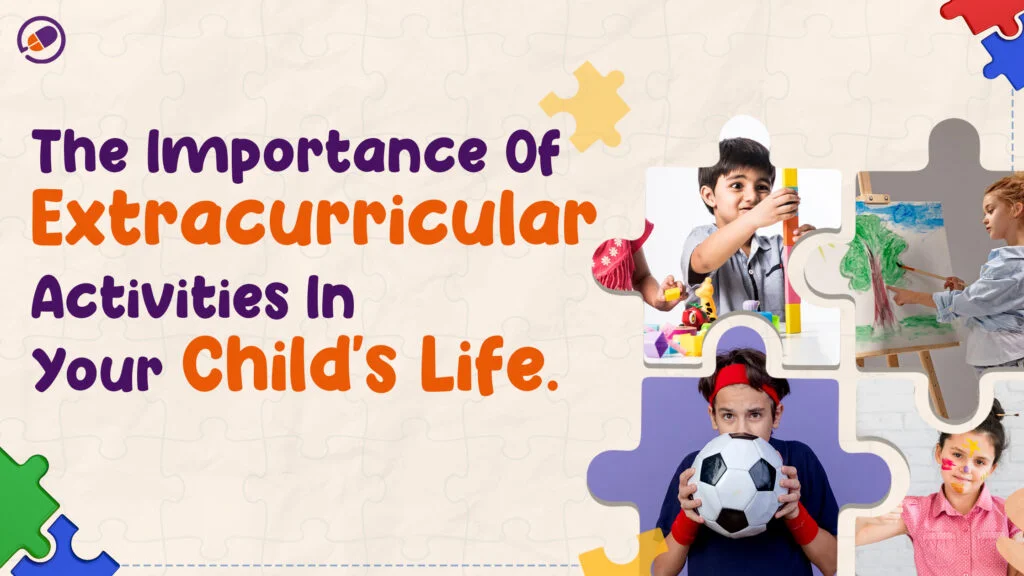
Your Child Has Gifts That No Report Card Can Measure. Are You Helping Them Find It?
Think back to the moments that shaped who you are today. Chances are, it wasn’t a textbook or a board exam. It was the thrill of scoring a goal, dancing in a room until the whole crowd disappeared, or singing until you felt that burning sensation deep in your lungs, those raw, electric moments where you forgot everything else and just lived.
This is exactly why the importance of extracurricular activities in a child’s life cannot be overstated and why Indian parents are rethinking what “success” really looks like for their children.
Today’s families understand that marks open doors, but personality, confidence, creativity, and resilience are what help children walk through them. Sports build grit. Music builds focus. Dance builds expression. Storytelling builds empathy. These aren’t “extras”; they are the building blocks of a well-rounded human being.
And yet, here’s a truth most parents discover the hard way: enrolling your child in activities isn’t enough. A child dragged to tennis practice they dread isn’t building confidence, they’re building resentment. The magic happens when the right activity meets the right support, and when parents learn to guide rather than push.
In an era where online schooling and flexible learning are reshaping how children grow up, the need for structured, meaningful extracurricular experiences is greater than ever. Children need spaces to collaborate, create, perform, and simply play beyond the pressure of academics.
So, how do you make extracurricular activities truly transformative for your child and not just another item on the schedule?
What Are Extracurricular Activities?

Extracurricular activities are structured, purposeful experiences that take place outside the core academic curriculum. While subjects like mathematics, science, and languages build knowledge, extracurricular activities build the person, developing creativity, confidence, teamwork, leadership, and communication in ways no textbook ever could.
Think of them as the other half of education. A child who scores well in science but has never collaborated under pressure, performed in front of an audience, or led a team is only partially prepared for the world. Extracurricular activities fill that gap.
By participating in different activities beyond the classroom, children discover hidden talents, develop new skills, and grow into more balanced, self-aware individuals. Many of these activities are also referred to as co-curricular activities because, rather than existing separately from academics, they actively support and deepen classroom learning. A child in a debate club becomes a sharper thinker in every subject. A child who plays team sports brings greater discipline to their studies.
Education boards, including CBSE, encourage schools to embed extracurricular activities within the broader learning environment, recognising that true holistic development encompasses a child’s academic, social, emotional, and physical growth, not just their exam results.
Here are the 5 key types of extracurricular activities found in schools today:
| Type | Examples | Skills Built |
|---|---|---|
|
Sports & Physical Activities |
Cricket, football, swimming, yoga, martial arts, athletics |
Physical fitness, discipline, resilience, teamwork
|
|
Creative Arts |
Dance, music, theatre, painting, photography, storytelling, writing |
Self-expression, artistic confidence, and emotional intelligence
|
|
Academic Clubs |
Debate, quiz, science club, reading circles, public speaking |
Critical thinking, communication, and intellectual curiosity |
|
Community Service |
Volunteering, environmental campaigns, charity initiatives |
Empathy, responsibility, civic awareness
|
|
Technology & STEM |
Coding, robotics, AI projects, app development, digital design
|
Logic, problem-solving, future-readiness
|
These categories are not walls, they are the benefits of extracurricular activities. A child in a robotics club is also building teamwork. A child in theatre is also developing public speaking skills for their future career. A child doing community service is also discovering leadership. The most meaningful extracurricular experiences tend to develop multiple strengths at once, quietly and naturally, while the child is simply doing something they love.
Why Are Extracurricular Activities Important?

Marks tell you what a child knows. Extracurricular activities for students reveal who they are becoming.
The importance of extracurricular activities goes far beyond keeping students engaged after class. Research consistently shows that children who participate in structured activities outside the classroom demonstrate stronger academic performance, healthier emotional lives, and more developed social instincts than those who do not.
But numbers only tell part of the story. The real impact shows up in quieter, more personal ways in the child who used to shrink in group conversations but now leads them, in the teenager who manages a packed schedule without being reminded, in the student who approaches every new challenge with curiosity instead of fear.
From building leadership and teamwork to nurturing creativity and mental resilience, the extracurricular activities for students touch every dimension of a child’s growth, academic, social, emotional, and physical. These are not side effects of participation. They are the point.
In the sections below, we explore 7 key ways the importance of extracurricular activities shapes children into confident, capable, and truly well-rounded individuals.
1. Boosts Academic Performance
There is a common assumption among parents that extracurricular activities take time away from studies. The reality is the opposite. They quietly build the habits that improve extracurricular activities and academic performance in a very real way.
When a child balances cricket practice with homework, they learn time management. Committing to weekly music lessons builds discipline. Preparing for a debate sharpens the same skills taught in the classroom. Extracurricular activities do not compete with academics. They strengthen the foundation that academics depend on.
Physical activities add another layer of impact. Sports, yoga, and movement improve blood flow to the brain, boosting focus, memory, and cognitive ability. This is one of the most overlooked benefits of extracurricular activities for students. A child who stays active is better prepared to concentrate and learn effectively.
The habits developed through consistent participation, showing up, practising under pressure, and working toward goals, directly translate into stronger academic outcomes. Children do not learn these skills through instruction alone. They build them through real experiences, whether on the field, on stage, or through hands-on projects, long before those lessons reflect in the classroom.
2. Develops Social Skills and Teamwork
Academics teach children what to think. Extracurricular activities teach them how to exist with other people, and that is a skill no curriculum has ever fully captured.
When a child joins a sports team, a drama club, or a debate group, they step into something a classroom rarely offers, a space where their success genuinely depends on others, and others’ success genuinely depends on them. They learn to understand not to respond, they learn to share responsibility, to trust a teammate, to disagree without derailing, and to show up even when the role they have been given is not the one they wanted.
Consider a shy eight-year-old who joins a theatre group. She dreads the first rehearsal. By the third, she has a best friend. By the final performance, she walks onto a stage in front of a hundred people, and she does not flinch. Nobody taught her confidence directly. She built it, slowly, through belonging.
For children in online learning environments, extracurricular activities aren’t optional, they’re essential. Without school corridors, lunch breaks, and shared classrooms, virtual clubs, group projects, and collaborative activities become the primary spaces where children build friendships, develop social skills, learn teamwork, and practise the communication instincts that will carry them through life.
Academic growth and social development are not separate tracks. They feed each other. A child who feels connected, heard, and part of something larger than themselves is also a child who learns better, takes more risks, and recovers faster from setbacks.
3. Builds Confidence and Self-Esteem
There is a particular kind of self-esteem and confidence that no exam result can give a child, the kind that comes from discovering, through their own effort and in front of other people, that they are capable of something they were not sure they could do. What makes extracurricular activities for students uniquely powerful for building-confidence is something you can actually see happen in real time.
Ask a question in a classroom and watch what happens. Half the room goes quiet. Eyes drop, hands stay down. Not always because students don’t know, but because being wrong feels public, graded, and judged. Now place those same students in a play rehearsal, a football drill, or a debate warm-up. Ask them to try something new, and suddenly every hand goes up. Even the quietest child is the first to step forward.
Why? Because the stakes have quietly changed. There’s no red pen. No mark in a register. No proof is required that they are capable, clever, or good enough. There’s just the doing of a thing, the trying, the falling short and going again, and nobody writing it down.
The importance of extracurricular activities becomes clear the moment you realise your child is not a machine meant to repeat perfect answers, but a thinker learning how to use their voice, their ideas, and their abilities in the world.
4. Teaches Time Management and Discipline
Nobody sits a child down and formally teaches them time management or screen time management. They usually learn it the hard way. The evening they realise their cricket kit is packed, but their homework is not, and practice starts in an hour. The moment they understand that the phone in their hand has quietly eaten up their study time, and that nobody will remind them unless a parent finally raises their voice and says, “Put the phone down, your homework still needs time.”
This is exactly how extracurricular activities for students build one of life’s most essential skills: not through instruction, but through consequence. When a child has somewhere to be that they genuinely want to be, they find a way to get everything else done first. The motivation is intrinsic. The lesson is real. And unlike a time management workshop or a productivity tip from a parent, it actually sticks.
The same dynamic builds discipline. A child preparing for a music recital does not practise because someone is watching; they practise. After all, the performance is coming, and they know the difference between being ready and not being ready. A student working toward a robotics competition learns that showing up inconsistently means falling behind a team that is counting on them. These are not abstract lessons about responsibility.
What begins as a simple weekly routine finish homework and then going to football quietly, compounds into something far more significant. Children who manage multiple commitments from a young age develop an internal sense of structure that follows them into secondary school, university, and professional life. They know how to prioritize. They know how to push through resistance. They know that the gap between wanting something and achieving it is almost always filled by consistent, undramatic effort.
5. Supports Mental Health and Reduces Stress
India’s academic environment is intense. Exams, assignments, performance pressure, and the weight of expectations can quietly wear a child down, often long before parents notice. Extracurricular activities are one of the most natural and effective antidotes to this pressure.
Physical activities like sports, yoga, and dance prompt the body to release endorphins, improving mood, reducing anxiety, and restoring energy. A child who moves their body regularly is not just healthier physically; they are more emotionally resilient, more patient, and better able to handle the demands of academic life.
Creative activities offer something different but equally valuable. Music, painting, theatre, and storytelling give children a safe space to process emotions they may not yet have words for. When a child loses themselves in a canvas or a melody, they are not wasting time. They are regulating their inner world in the healthiest way possible.
Social activities add another layer of protection. Team sports, clubs, and group projects build friendships and a genuine sense of belonging. For children who feel isolated or overlooked in a purely academic environment, these connections can be genuinely life-changing.
A child who is emotionally balanced, physically active, and socially connected does not just feel better. They learn better, sleep better, and face challenges with far greater steadiness than a child running on academic pressure alone.
6. Prepares for Future Career and College Admissions
Universities and employers are increasingly looking for people, not just performers. They want to see evidence of curiosity, initiative, resilience, and the ability to collaborate under pressure. These qualities rarely show up on a mark sheet. They show up in what a student chose to do when nobody was asking them to do anything.
The child who spent 3 years in a debate club is not just a better public speaker. They are someone who has learned to construct an argument under pressure, listen to a perspective they disagree with, and think clearly when the room is watching. The child who led their school robotics team through a national competition has already experienced what it feels like to manage people, solve unexpected problems, and deliver results with a deadline. These are not entry-level professional skills. They are the skills most adults spend years trying to develop.
College admissions processes, particularly at competitive institutions, reflect this understanding. A well-rounded applicant who demonstrates genuine commitment to something beyond academics signals something important: that they are the kind of person who engages with the world, not just with the syllabus.
The confidence built on a sports field, the communication skills sharpened in a theatre production, the leadership forged in a student club, none of it stays contained to the activity that created it. It travels forward, into every interview, every team, and every challenge a child will face long after school is behind them.
7. Encourages Creativity and Critical Thinking
We are raising children who will share the world with artificial intelligence. The question parents should be asking is not whether their child can memorise and reproduce information. Machines do that faster and better than any human ever will. The real question is whether their child can imagine, create, connect ideas in unexpected ways, and solve problems that do not yet have known answers.
These are the skills extracurricular activities develop. And no algorithm can replicate them.
When a child paints, they are not just making art. They are learning to observe the world with intention, to make decisions about what matters and what does not, and to communicate something true without using a single word. When a child writes and performs in a play, they are practising empathy at its most demanding level, inhabiting a perspective entirely different from their own and making it believable to an audience. These are cognitive and emotional capacities that take years to develop and a lifetime to refine.
The child who grows up drawing, building, performing, and problem-solving across different extracurricular experiences does not just become more creative. They become genuinely harder to replace, in a classroom, in a career, and in a world that will increasingly reward the people who can think in ways that cannot be automated.
What Does NEP 2020 Say About Extracurricular Activities?

For decades, Indian education followed an unspoken hierarchy where subjects like maths and science were prioritised, while arts, sports, and creative pursuits were treated as secondary. National Education Policy 2020 changes this perspective completely.
The policy does not simply recommend extracurricular activities. It emphasises that arts, sports, vocational learning, and skill-based activities should be integrated into everyday education at every stage. Under NEP 2020, these are not optional add-ons but an essential part of learning.
Through its 5+3+3+4 curricular structure, the policy promotes age-appropriate, experiential learning where children learn by doing, creating, collaborating, and reflecting rather than only memorising.
For parents, this shift changes how schools should be evaluated. Institutions that treat music, dance, coding, sports, and community projects as core parts of education are not offering extras. They are aligning with the national vision that values holistic development as a fundamental responsibility of education.
Can Online Schools Offer Extracurricular Activities?

A common concern among parents considering online schooling is whether their child will miss out on extracurricular activities. It is a fair question, and the answer, for well-designed online schools, is a confident no.
Modern online schools understand the importance of extracurricular activities and offer structured extracurricular experiences through virtual clubs, live activity sessions, interactive workshops, and collaborative group projects. Students participate in coding clubs, debate competitions, music classes, storytelling sessions, and art workshops through live platforms that allow real interaction with peers and teachers.
Beyond screens, many online schools extend extracurricular learning into the home itself through guided fitness sessions, yoga, dance practice, and hands-on creative or STEM projects. Some schools, like Cyboard school, send physical activity kits directly to students, ensuring that learning remains tactile, engaging, and well-rounded.
Tips for Parents: How to Choose the Right Extracurricular Activities

Choosing the right activities for your child is not about picking what looks impressive, it is about finding what truly fits. That is where the importance of extracurricular activities really comes into play. The right choice unlocks the real benefits of extracurricular activities for students, while the wrong one can feel like just another burden.
Here are 6 practical ways to get it right:
Observe natural interests first
Pay attention to what your child is naturally drawn to. Genuine curiosity is a far better guide than parental expectations when selecting extracurricular activities for students.
Avoid over-scheduling
One or two well-chosen activities are enough. Overloading defeats the purpose and reduces the real benefits of extracurricular activities, turning growth into stress.
Allow exploration and flexibility
Children evolve, and so do their interests. Let them try different types of extracurricular activities until something clicks. A few wrong choices are part of the process.
Focus on enjoyment, not just competition
If a child enjoys the activity, improvement follows. Pushing performance too early often backfires and undermines the true importance of extracurricular activities.
Choose age-appropriate activities
Younger children benefit from creative and movement-based activities, while older students are ready for structured programmes. The right stage matters when choosing effective extracurricular activities for students.
Maintain a balanced mix
A combination of physical, creative, and intellectual activities ensures overall development. This balance is where the real benefits of extracurricular activities are fully realised.
At the end of the day, the goal is simple. Choose activities that help your child grow, not just perform. That is the real value behind every smart decision in this space.
ScienceDirect says that the quality of parent–child interaction matters just as much as exposure. Children growing up in families with open communication, encouragement, and collaborative discussions are more likely to develop confidence, independence, and leadership qualities.
How Cyboard School Integrates Extracurricular Activities
At Cyboard, learning goes beyond academics to support the overall development of every child. The school understands the importance of extracurricular activities and believes they are essential for building real-world skills alongside academics, which is why they are thoughtfully integrated into the learning experience.
Students participate in activities such as Art and Crafts, online quizzes, which help develop creativity and improve fine motor skills. Dance sessions encourage physical fitness while also helping children understand rhythm and cultural expression. Through Music, students learn emotional expression, patience, and better concentration.
Activities like Storytelling strengthen communication skills and spark imagination, while Theatre helps students build confidence and become comfortable with public speaking. Physical activities promote healthy habits, discipline, and teamwork. In addition, Coding sessions introduce students to critical thinking, problem-solving, and future-ready technology skills.
Cyboard also enhances learning through its Fun Box activity kit, hands-on projects, and structured progress tracking through the LMS. This approach supports AI-powered learning and aligns with the holistic vision of NEP 2020, followed by modern online schools in India.
Today, Cyboard students are growing both academically and passionately pursuing their interests. Many are excelling in diverse fields such as MMA fighting, karate, roller athletics, skateboarding championships, gymnastics, chess competitions, creative writing, and even content creation. These students understand the true value of extracurricular activities and are now flourishing not only in their academics but also while confidently following their dreams and passions.
In Summary
Extracurricular activities are not extras. They never were. They are where children discover what they are capable of, build the confidence to try harder things, learn to work alongside other people, and develop the resilience that no exam can measure and no certificate can truly capture. Every skill that makes a person genuinely employable, genuinely likeable, and genuinely fulfilled in adult life has its roots in experiences exactly like these.
NEP 2020 recognises this, and increasingly, parents across India are recognising it too that raising a well-rounded child means investing in the whole child, not just the academic one.
At Cyboard School, this is not a philosophy we revisit occasionally. It is built into every school day, every activity session, and every interaction we design for our students. We believe that a child who is curious, confident, creative, and kind is not just a good student. They are a good human being in the making.
Give your child the gift of all-round development. Explore Cyboard School’s admission process today and take the first step toward an education that goes far beyond the classroom.
Frequently Asked Questions
Q1. Why are extracurricular activities important for students?
Q2. What are the benefits of extracurricular activities?
Q3. What are examples of extracurricular activities?
Q4. How do extracurricular activities help in academics?
Q5. Can online schools provide extracurricular activities?
Q6. What does NEP 2020 say about extracurricular activities?
Q7. How many extracurricular activities should a child do?
Explore More on Cyboard School