


Aadhaar has 12 digits. So does APAAR ID. That is where the confusion starts, and many parents assume the new school form is just some other version of Aadhaar. In reality, it is not.
APAAR ID is a separate, lifelong academic ID that keeps a student’s marksheets, certificates, and achievements in one place. Imagine a student’s entire academic history, from Class 1 results to college marksheets, in one secure digital folder that is much harder to lose or replace. That is the idea behind APAAR.
It is linked to Aadhaar, which is why parents have questions about consent and data.
This guide explains what is APAAR ID, its full form, how it differs from ABC ID, and what parents should know before they decide.
What is APAAR ID?
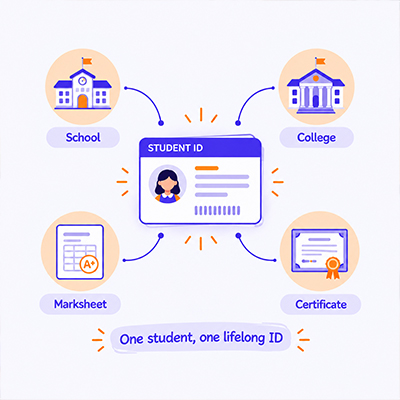
APAAR ID is a unique, 12-digit, lifelong, paperless ID for Indian students, created under the government’s “One Nation, One Student ID” initiative. It brings a student’s academic records such as marksheets, certificates, and extracurricular achievements in one digital place linked to DigiLocker.
The Ministry of Education (MoE) introduced it as part of NEP 2020. For school students, the school generates it through the UDISE+ system, using the child’s Permanent Education Number (PEN), once a parent has given consent. The ID is then added to the student’s DigiLocker account.
So, a simple way to think about it: Aadhaar identifies the person, and APAAR ID identifies the student’s academic record. APAAR is linked to Aadhaar, which is why privacy questions come up, and that’s what we cover in the rest of the guide.
APAAR ID Full Form

APAAR stands for Automated Permanent Academic Account Registry. Each word describes a part of the idea:
- Automated: No more standing in queues to collect physical marksheets from school. Results will be directly updated online.
- Permanent: The ID stays with the student for life, even on changing boards or schools.
- Academic: It covers education records such as marks, credits and certificates.
- Account: Each student has a personal profile.
- Registry: The records sit in one central, national system.
What Is APAAR ID for Students?

For a student, APAAR ID works like a digital file that follows them from school to college. According to the official APAAR portal, it helps students store, manage and access their academic credits, including score cards, marksheets, grade sheets, degrees, diplomas, certificates, and co-curricular achievements.
For school students, the process the portal describes has four steps:
- Parents learn about APAAR at school.
- Parents give consent on the form. For a minor, consent is required.
- The school generates the APAAR ID through UDISE+, against the student’s PEN.
- The ID is pushed into the student’s DigiLocker account.
You can read the full process on the official APAAR portal. It is important to note that officially, the APAAR ID is voluntary for students. The portal clearly says that parents need to fill out a consent form, and no ID can be generated for a minor without that consent.
Benefits of APAAR ID for Students and Parents

- One record for life. Marksheets and certificates sit in one place, not in scattered paper files.
- Fewer problems when changing schools. The ID is permanent, so it stays the same whichever school the student attends.
- Easier verification. Institutions can check records digitally instead of asking for photocopies.
- A smoother path to college. APAAR connects to the Academic Bank of Credits, which stores credits in higher education.
- A fuller picture than marks. Co-curricular achievements can be recorded alongside academic results.
These benefits grow as schools and colleges upload more records, so the full value builds over time and does not appear on day one.
Is APAAR ID and ABC ID Same?
Short answer: the ID is the same, but the two names describe different things.
The Ministry of Education’s factsheet on the Academic Bank of Credits says that the earlier ABC ID has been renamed APAAR ID. So when a college asks for your ABC ID, it means your APAAR ID. The Academic Bank of Credits (ABC) itself is a different thing: a digital system, regulated by the UGC, where a student’s credits are stored, transferred, and redeemed.
| Comparison | APAAR ID | Academic Bank of Credits (ABC) |
|---|---|---|
| What it is | A 12-digit lifelong student ID | A digital platform for academic credits |
| Who runs it | Ministry of Education | Ministry of Education, with UGC oversight |
| Who uses it | School and college students | Mainly higher education students |
| What it does | Identifies students and links their academic records | Stores, transfers, and facilitates the redemption of academic credits |
| How to access it | Through the school or DigiLocker | Through the ABC portal and DigiLocker |
In short, the ABC APAAR ID is one number, and the Academic Bank of Credits is where it gets used. You can read the details in the government’s factsheet on ABC and APAAR.
APAAR ID Registration: Step-by-Step Guide for Parents
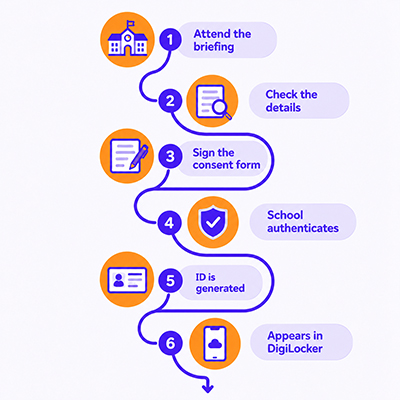
For students, the school usually creates the ID. As a parent, you don’t apply on the website. Your part is to give consent and make sure your child’s details are correct.
What the School Needs Before Creating the Official ID?
The following details are listed as mandatory according to the official APAAR portal:
- The student’s PEN (Permanent Education Number).
- Name, Date of Birth, and Gender
- Mobile Number
- Mother’s and father’s names
- Name as per Aadhaar & Aadhaar Number
The student’s name in the school records (UIDSE+) must match the name on Aadhaar. Check spellings and the mobile number before the school submits anything.
What Parents Should Know About APAAR ID?
In practice, many parents reported that schools treated the APAAR ID as compulsory. The Supreme Court looked at this in July 2026. It directed that the consent form must clearly allow parents to refuse, across India, and said student data must be handled under the Digital Personal Data Protection Act, 2023. You can read a summary of the Supreme Court’s order here.
Before you sign, it helps to ask the school:
- What data is collected, and why?
- How long is it kept, and who can see it?
- Is the form the revised version with a clear option to refuse?
For school students, the school creates the ID after you give consent, and you can find it in the “Issued Documents” section of your child’s DigiLocker account.
Conclusion
APAAR ID is a lifelong academic ID that brings a student’s records into one digital place. It is the same number as the earlier ABC ID, while the Academic Bank of Credits is the system where college credits are stored.
For parents, the key points are simple: it is officially voluntary, consent is required for minors, and you have the right to ask how your child’s data will be used. Read the form carefully, ask the school your questions, and use only the official portals. Making a calm, informed decision matters more than rushing to sign.
Frequently Asked Questions on APAAR ID
Is APAAR ID mandatory for school students?
What is the full form of APAAR ID?
Where to find APAAR ID and ABC ID?
Is APAAR ID and ABC ID the same?
Is my child’s data safe with APAAR?
Does the APAAR ID change if my child changes school?
Explore More on Cyboard School