
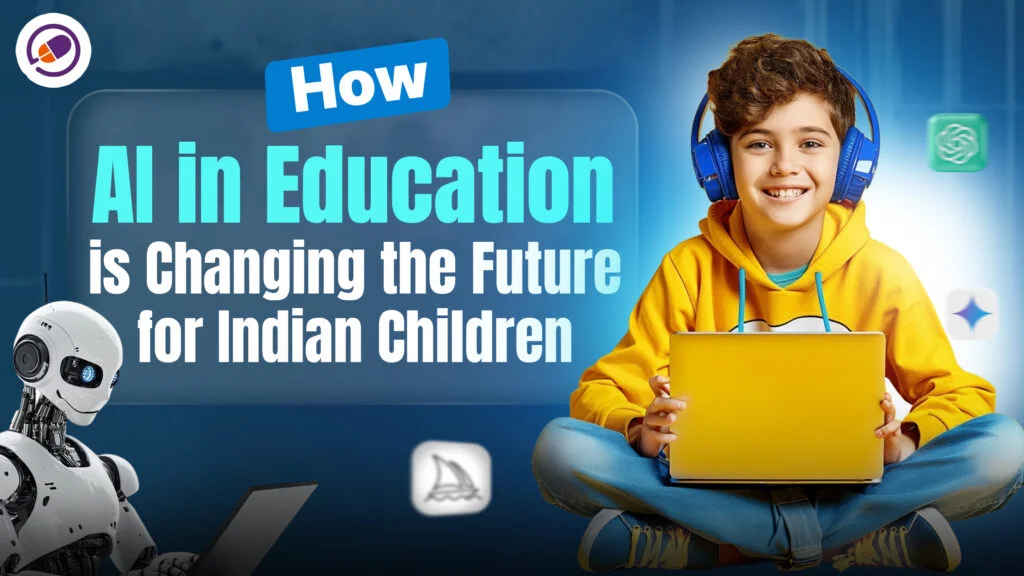
Think about this for a second: In 2025, over 378 million people are already using AI tools every single day. AI is no longer a futuristic concept reserved for tech companies or science fiction. It has become a part of everyday life, and education is one of the areas seeing the biggest transformation.
AI in education is quietly reshaping the way students learn, and teachers teach, making lessons more personalised, feedback faster, and learning far more effective. From customised study plans to instant doubt-solving and smarter classroom management, AI is changing the learning experience in ways that were difficult to imagine just a few years ago.
So, if you have been wondering whether AI actually belongs in schools, the answer is simple: it is already here. The real question now is not whether schools should use AI, but how they can use it in the right way.
What Is AI in Education & How Does It Work

Most people hear AI in education and picture some fancy sci-fi classroom. The reality is a lot simpler and, honestly, more useful. It’s technology that figures out how a student learns best and adjusts to that. No two students get the same experience. That’s the whole idea.
How AI is used in schools in India has grown quietly over the last few years. Platforms like BYJU’S and Vedantu started the shift to personalising lessons based on where students were getting stuck. Since then, it’s spread further. Smart classrooms, instant assessment tools, after-hours doubt bots, schools across India are picking this up faster than most people realise.
Cyboard School is a solid example of this in action. Our AI-powered Learning management system tracks each student’s progress, flags where they need help, It also keeps teachers and parents informed at all times, eliminating the need for constant follow-ups or repeated communication.
At the policy level, artificial intelligence in Indian schools got a real push with NEP 2020, which put personalised, technology-backed learning at the centre of the country’s education goals, not just in premium private schools.
The goal was never to replace teachers, but to support them by reducing the burden of grading, administrative tasks, and routine tasks, allowing them to dedicate more time to meaningful teaching and student engagement.
Why Artificial Intelligence in Schools Is No Longer an Option

There was a time when AI in schools felt like something far off. Something schools would get to eventually. That time has passed. What is happening now in Indian education is not a slow build. It is a shift that is already underway and picking up speed.
The Indian government has made its position clear. The Union Budget 2025–26 set aside Rs 500 crore to establish an AI Centre of Excellence for Education. As AI continues to reshape classrooms, parents and educators are increasingly relying on educational technology insights to stay informed about emerging trends and innovations in learning. When that kind of funding goes into a single area, it tells you where the country’s priorities are headed.
On top of that, India is set to bring an AI curriculum into all schools from Grade 3 starting the 2026–27 academic year. So AI for students in India is not a conversation about the future anymore. It is a decision that has already been made at the national level.
Globally, UNESCO dedicated the 2025 International Day of Education to AI and Human Agency. That alone says a lot about how seriously the world is taking this shift in classrooms.
For parents, the concern is real. The future of education in India is being built around schools that are ready for this change. Schools that are not moving in this direction are quietly falling behind, and children in those schools may not realise it until it matters most.
This is why understanding the policy framework around artificial intelligence in Indian schools is so important, and that is exactly what NEP 2020 and the National Curriculum Policy are trying to address.
What NEP 2020 and AI in Education Mean for Your Child

A lot of parents have heard about NEP 2020 but are not entirely sure what it actually changes for their child. When it comes to technology in classrooms, the policy is quite direct. NEP 2020 and AI in education are formally linked. It focuses on making learning more flexible, skill-based, and student-centred. The policy aims to move beyond rote memorisation and encourage critical thinking, creativity, communication, and practical knowledge.
The policy also explicitly mandates the integration of AI and emerging technologies across all levels of learning. This is not a suggestion. It is written into the framework that schools are expected to follow.
The National Curriculum Framework takes this further by bringing coding and computational thinking into early grades. So even before a child hits secondary school, the expectation is that they are already building a foundation in how technology works and how to think through problems using it.
At present, 880 schools have registered with CBSE to introduce AI as a skill subject for Classes 8 and 9. The larger goal is to ensure that all 22,000 CBSE schools become familiar with AI and other emerging technologies, allowing students to build future-ready skills from an early stage.TimesofIndia
What this means in practice is that AI literacy has moved from being a nice-to-have to a formal part of India’s education roadmap. Schools that are aligned with NEP 2020 and AI in education are the ones keeping pace with where policy is headed.
Parent checklist questions worth asking your child’s school
- Does the school offer AI literacy in any form, even as part of an existing subject?
- Is the curriculum aligned with NEP 2020 and NCF 2023 guidelines?
- Have teachers received any training on AI tools or computational thinking?
- Is coding or computational thinking introduced before Grade 6?
These are not difficult questions to ask, but they are important ones. To understand exactly what the policy says and what a compliant school should look like, you can read through the NEP 2020 guidelines on Cyboard School’s dedicated page.
Key Benefits of AI in Education for Students

The benefits of AI in education go well beyond smarter classrooms. For AI for students in India, the impact is showing up in how they learn, how their teachers engage with them, and the kind of thinking they are developing from an early age.
Personalised Learning
AI adjusts content difficulty based on how each child learns and at what pace. A student who needs more time with a concept gets it without holding the class back. One who is ready to move ahead does not have to wait. Personalised learning means every child gets a version of the lesson that actually works for them.
Closing the Rural-Urban Gap
AI-powered platforms now deliver quality content in regional languages, giving children in smaller towns access to learning they simply did not have before. A student in a tier-3 town can now access the same standard of instruction as someone in a metro city. That is a significant shift in who gets access to good education.
Better Teacher Effectiveness
When AI handles grading, attendance tracking and routine assessments, teachers get their time back. That time goes into mentoring, creative instruction and actually noticing which students need support. The quality of individual attention a child receives in class goes up when teachers are not buried in administrative work.
21st-Century Skill Development
AI education does not just teach children about technology. It builds how they think. 21st-century skills like coding and critical thinking are embedded into how children engage with AI tools, not bolted on as separate subjects. Data literacy, problem structuring and logical reasoning develop as natural byproducts.
Ethical Thinking and Digital Citizenship
Learning how AI works also teaches children how to use it responsibly. Understanding bias, privacy and misinformation from a young age builds digital citizenship that stays with them. For children growing up in an AI-driven world, knowing ways to improve critical thinking in children is as important as any academic subject.
Challenges Facing AI Adoption in Schools

While the benefits of artificial intelligence are growing, many schools still face barriers when it comes to adoption. One of the biggest challenges is the lack of proper digital infrastructure. Many schools, especially in smaller towns and rural areas, still struggle with limited internet access, outdated devices, and insufficient computer labs.
Another major concern is teacher readiness. Many educators are not yet trained to use AI-based tools confidently in the classroom. Without proper guidance, even the best technology can remain underused. Schools also worry about the cost of implementing advanced digital systems, which can be difficult for budget-conscious institutions.
Data privacy and student safety are additional concerns. Parents and schools want assurance that children’s personal information is protected and that AI tools are being used responsibly. There is also a fear that too much dependence on technology could reduce creativity, human interaction, and critical thinking in students.
Despite these concerns, AI in education in India is gradually moving forward. Government initiatives, improved internet connectivity, teacher training programs, and growing awareness among parents are helping schools become more open to adopting AI in a balanced and responsible way.
How Cyboard School Is Already Teaching AI-Ready Education to Children
As the demand for future-ready skills continues to grow, Cyboard School is becoming the best online school in India with AI-powered learning by combining technology, practical exposure, and a child-focused learning experience.
NEP 2020 and NCF 2023
Cyboard School follows a curriculum designed around the goals of NEP 2020 and NCF 2023. This ensures that students are not limited to textbook learning alone but are also introduced to digital literacy, critical thinking, communication skills, computational thinking, and problem-solving from an early age.
The curriculum is designed to help children become comfortable with technology while also building the human skills that remain equally important in the future. Through its school curriculum, Cyboard School encourages students to think independently, explore new ideas, and adapt to changing educational needs.
Bringing AI Learning Into the Home
One of the biggest limitations of online education is the lack of hands-on learning. Cyboard School addresses this through its Fun Box kit, which is delivered directly to students at home.
The Fun Box kit includes creative learning materials, activity-based resources, and practical tools that make lessons more interactive and engaging. It helps students move beyond screen-based learning and understand concepts through touch, experimentation, and observation. In the growing landscape of AI in education in India, this combination of digital and physical learning creates a more balanced educational experience.
Cyboard's Advanced LMS
Cyboard School also supports personalised learning through Cyboard’s Learning Management System. The platform uses learning level tracking to help parents and teachers understand a child’s academic progress more clearly.
This system provides visibility into subject understanding, strengths, weak areas, and skill mastery. Instead of only focusing on marks, it helps track whether a child is learning at the right pace and where additional support may be needed. This allows parents to stay informed while giving teachers the ability to guide students more effectively.
Building Future-Ready, Holistic Learners
Cyboard School believes that future-ready education goes beyond academics. Its beyond-academics programmes include extracurricular activities, performing arts, communication skills, creativity-based learning, and confidence-building sessions.
These experiences help children develop teamwork, emotional intelligence, adaptability, leadership, and social skills that are essential in an AI-driven world.
Parents who want their children to stay ahead in a fast-changing world can explore how Cyboard School is building strong academic foundations along with the digital, creative, and life skills needed for the future.
Frequently Asked Questions (FAQs)
What is AI in education, and why does it matter for Indian students?
How is AI currently being used in Indian schools?
What does NEP 2020 say about AI in school education?
Is AI education only for children interested in technology?
At what age should a child start learning about AI?
What is personalised learning, and how does AI enable it?
How does Cyboard School incorporate AI-aligned learning into its curriculum?
Explore More on Cyboard School