

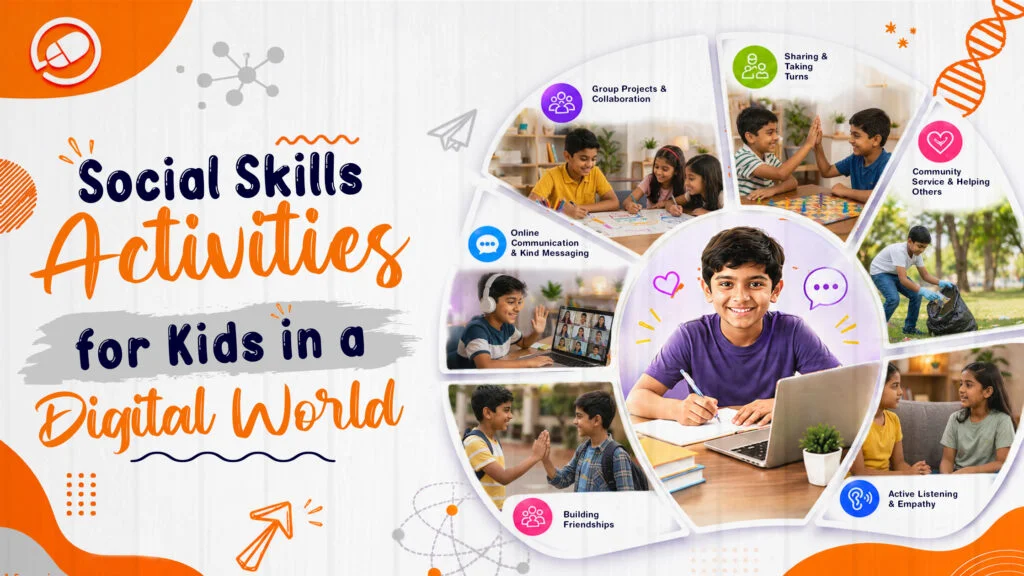
Parenting in 2025 looks nothing like it did even a decade ago. Your child may confidently spend hours interacting with online friends and navigating digital spaces, yet still feel uncomfortable starting a real-life conversation, making eye contact with neighbours, or responding when someone asks for directions in person.
We’re raising a generation that knows how to use social media and smile for the camera, but many children still struggle with face-to-face conversations and meaningful connections.
In today’s digital world, building strong social skills is more important than ever. But the good news is? Helping children build meaningful connections with others does not require completely removing screens from their lives. It means creating opportunities to communicate, collaborate, and build confidence both online and offline.
Here are some simple and effective social skills activities that can help.
Why Social Skills Are Important?

Social skills, things like listening, taking turns, reading emotions, resolving conflict, and showing empathy, are the invisible scaffolding of a child’s entire life. Research consistently links strong social skills in childhood to better academic performance, healthier relationships, and even greater career success as adults.
Yet screen time, while not inherently harmful, can quietly reduce the practice reps kids get for face-to-face interaction. When your child texts instead of calls, watches instead of plays, or plays alone instead of with a group, those are missed opportunities to flex their social muscles.
The answer isn’t to eliminate screens. It’s to balance them with activities that build human connection.
Top 6 Social Skills Activities to Build Confidence and Connection

1. Weekend Hobby Classes for Socialising
One of the most underrated moves a parent can make is enrolling their child in a weekend hobby class, not just for the skill, but for the social experience it provides.
a pottery class, a drama workshop, a chess club, or even a cooking session puts your child in a room with peers who share a common interest. That shared interest is social gold. It gives kids a natural reason to talk, collaborate, ask questions, and cheer each other on without the pressure of “just go make a friend.”
Weekend hobby classes work particularly well because:
- The focus is on doing something together, which takes the awkwardness out of conversation.
- Kids interact with peers across different schools and neighbourhoods, widening their social circle.
- Repeated sessions build familiarity and trust over time, the foundation of friendship.
- They learn to navigate group dynamics, follow instructions from other adults, and handle both winning and losing graciously.
If your child is shy or hesitant, start with something they already love. A child who lights up over art will find it much easier to open up in an art class than in an unfamiliar social setting.
Tip
Attend a trial session together first. After they observe the setting and get familiar with the instructor, they often start feeling more comfortable and confident.
2. Collaborative Drawing Online Creativity Meets Connection
Collaborative drawing online is exactly what it sounds like, platforms or apps where multiple kids (or a parent and child) draw together in real time on a shared canvas. Tools like Skribbl.io, or even multiplayer drawing games, make this surprisingly fun and surprisingly social.
What’s special about collaborative drawing online as a social skills activity is how many invisible lessons it teaches:
- Turn-taking and patience.
When someone else is drawing, you wait. You watch. You guess. That’s active listening in a digital form. - Communicating ideas.
Trying to make your teammate figure out a word like “waterfall” just from your sketch is a fun test of how well you can think and communicate creatively in a high-pressure moment. - Handling mistakes with humour.
Bad drawings happen. Kids learn to laugh together rather than get frustrated. - Building on each other’s ideas.
In shared canvas tools, kids literally add to what someone else started, a beautiful metaphor for collaboration.
For younger kids, a parent joining in makes it even better. You’re not just supervising, you’re modelling how to play alongside someone, take turns, and make it fun when things go sideways.
Collaborative drawing online is also a wonderful way for kids to connect with cousins, old classmates, or friends who’ve moved away, keeping relationships warm across distance.
ScienceDirect says that collaborative learning helps children develop stronger social skills, critical thinking abilities, confidence, teamwork, communication, and emotional well-being. When students work together in groups, they build empathy, improve problem-solving skills, develop positive relationships, and become more actively involved in learning.
3. Volunteer Work for Students
Volunteer work for students does something that no classroom activity quite replicates, it places young people in real situations with real stakes, alongside people who are different from them. Whether it’s volunteering at an animal shelter, helping at a community kitchen, tutoring younger children, or participating in a neighbourhood clean-up, the social learning that happens is profound.
Here’s what kids actually gain from volunteering:
- Empathy in action.
Hearing about people in difficult circumstances is one thing. Sitting with them, serving them, or simply acknowledging them is another. Empathy deepens when it’s lived, not just learned. - Confidence through contribution.
Many children, particularly those who are quiet or introverted, tend to open up more in volunteer settings where the focus is on helping rather than competing. With no grades or performance pressure involved, they feel freer to participate, build connections, and develop confidence through real contribution. - Teamwork with diverse groups.
Volunteer environments tend to mix ages, backgrounds, and abilities in ways school rarely does. Navigating that is incredible preparation for adult life. - Conversation skills with adults.
Talking to a 60-year-old volunteer coordinator or a younger child you’re tutoring requires different social registers. Kids build that flexibility naturally through volunteering.
Even one Saturday a month can make a meaningful difference. Start with something close to their heart. If they love animals, start at a shelter. If they enjoy reading, explore a library reading programme. Connection follows passion.
4. Family Bonding Activities That Secretly Build Social Skills
Family bonding activities done intentionally are one of the most powerful ways to raise socially capable children. The reason? Family is where kids first learn to express themselves, disagree respectfully, wait their turn in conversation, and feel truly heard.
Some family activities that double as social skills training:
- Board games and card games – Beyond the fun, games teach negotiation, patience, graceful losing, and strategic thinking. Even a heated round of Uno has social value.
- Cooking together – Assigning each family member a role in the kitchen teaches cooperation, following instructions, and working toward a shared goal. Plus, someone always burns the onions, and everyone has to deal with that together.
- Storytelling circles – one person starts a story with two sentences, then passes it around the table. It builds listening, creativity, and the very underrated skill of building on what someone else said rather than hijacking the conversation.
- Outdoor family challenges – A scavenger hunt, a nature walk with a mission, or even building something together in the backyard creates low-stakes teamwork. Kids learn to communicate, delegate, and problem-solve when the pressure is playful rather than academic.
- Screen-free evenings – Once a week, put devices away and just be together, talk, play, or do nothing particularly structured. The skills built in those unscripted moments are irreplaceable.
Family bonding activities also give children a secure emotional base from which they feel confident enough to connect with the wider world. Kids who feel deeply connected at home tend to be more open, trusting, and resilient socially.
5. Drama, Role-Play, and Storytelling Classes
Few social skills activities develop social and emotional intelligence as directly as drama. When a child steps into a character, even a made-up one, they practice seeing the world through another person’s eyes.
Drama classes teach children to project their voice, read body language, manage nerves, and respond in the moment. They also put kids in collaborative situations where the group can only succeed if everyone contributes.
Even if your child insists they’re “not a performer,” look for storytelling or improv workshops. These tend to feel less like theatre and more like games. Improv, in particular, is remarkable for social development. The entire foundation of it is listening carefully to what someone says and building on it.
6. Team Sports and Movement-Based Activities
Sport creates a shared goal with real consequences. When you drop the ball (literally), your teammates feel it. When you score, everyone celebrates. That feedback loop where your actions genuinely affect others teaches accountability and connection in a way that’s hard to replicate.
Sports also offer a crash course in navigating conflict disagreements on the field, dealing with a difficult teammate, or losing to a rival while staying gracious. These are life skills wrapped in a jersey.
Movement-based activities like martial arts, dance, or yoga with a group also count here, they involve synchronisation, instruction-following, and mutual encouragement even without a scoreboard.
Balancing Screen Time with Social Skill Building

Screens are a normal part of childhood today, and they are not the enemy. The goal is not to eliminate screen time but to make sure it doesn’t replace opportunities for meaningful human interaction.
A child can enjoy video games, social media, or online activities while still developing strong social skills. What matters is having a healthy mix of experiences. When children regularly participate in family conversations, hobby classes, sports, volunteer work, or other group activities, they get the practice needed to build confidence, empathy, communication, and teamwork.
Instead of focusing only on the number of hours spent on a screen, pay attention to the quality of your child’s interactions throughout the week. Are they talking with others, working together, solving problems, and building relationships?
If the answer is yes, they are developing the social skills needed to thrive both online and offline.
Understanding and Nurturing Introverted Kids

Not every child will thrive in every setting on this list, and that’s completely okay.
Introverted children are not socially underdeveloped. They often have deep, rich inner lives and form meaningful connections with a small group of close friends. The goal for introverted kids isn’t to make them more extroverted, it’s to make sure they have the skills to connect when they want to and the confidence to navigate social situations without anxiety.
For introverted children, smaller group activities, one-on-one volunteer pairings, or low-pressure collaborative activities like drawing or cooking together tend to work better than large, boisterous group settings.
Bringing It All Together
Raising a socially confident child in a digital world isn’t about following a formula. It’s about staying curious and intentional. It’s noticing when your child seems isolated and nudging them gently toward connection. It’s choosing a weekend hobby class not just for the skill it teaches, but for the friendships it might spark. It’s sitting down for a family game night and recognising that the laughs around that table are doing important work.
The digital world your child is growing up in has real gifts, creativity, global connection, collaborative drawing online with a cousin three cities away and challenges.
Your job isn’t to choose one world over the other. It’s to help them navigate with grace, empathy, and a genuine curiosity about the people around them.
That’s what social skills activities really are, the courage and ability to show up for other people. And that is something truly worth building through everyday experiences and connection.
Frequently Asked Questions
1. Why are social skills important for children?
2. What are some effective social skills activities for kids?
3. Can online activities help children build social skills?
4. How do weekend hobby classes improve social skills?
5. Are social skills activities helpful for introverted children?
How can parents encourage social skills in a digital world? Photo from Admin Dashboard?
Explore More on Cyboard School