
Choosing an online school for your child? Then two questions must be on your mind. Firstly, is this school even genuine, and will my child’s certificate be accepted later? Great questions, and the answer starts with understanding what ‘accredited’ really means.
In short, an accredited online school is one whose quality has been reviewed by an independent accrediting organisation against a set of standards. But this isn’t the whole story. Board recognition also plays a major role in deciding whether your child’s Class 10th and 12th certificates are actually valid. These two are often confused, and that’s what we have covered in this guide.
This guide covers what an accredited online school is, shows you how to verify any school’s claims, and gives you a checklist for choosing the best accredited online school in the country.
What is an Accredited Online School?

An accredited online school is one that has undergone an external quality review by an independent accrediting body. The quality review includes areas such as curriculum, school policies, the teaching practices adopted by the school, student support, assessment, and technology.
Think of accreditation as a quality check. It tells you that a separate body has examined the school against its own standards and quality metrics. Accreditation itself does not decide which board exam your child will take or how the certificate is treated by other colleges.
Why should parents look for accreditation?
- It signals that processes such as teaching standards, student well-being, and assessment are properly checked by a separate body.
- It gives you something concrete to verify, rather than just relying on marketing claims.
- It shows that the school values outside review and is working towards continuous improvements in the teaching methodologies.
Accreditation vs Board Certification vs Affiliation
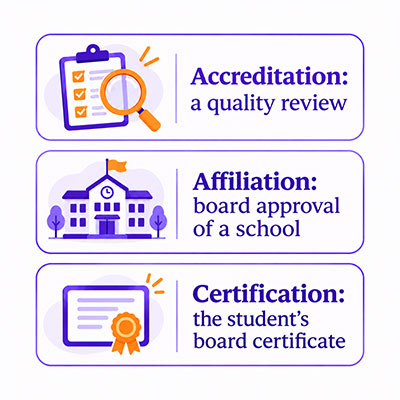
Term | Who Grants It | What Does It Mean |
Accreditation | An independent accrediting organisation, like IAO | The school’s quality systems have been reviewed externally |
Affiliation | Government Boards like CBSE, ICSE, etc. | The school meets the board’s norms for running as an affiliated school |
Board Certification | Boards like CBSE or an autonomous body under the Ministry of Education like NIOS, recognised on par with CBSE, ICSE, and other state boards | The student’s class 10th and 12th Board certificates come from a national board |
A trustworthy school must be able to tell you clearly the accrediting body, the accreditation details, and which board conducts the secondary as well as senior secondary examinations. For a quick, parent-friendly primer, read our other guide on accreditation vs affiliation.
What makes an online school recognised in India?
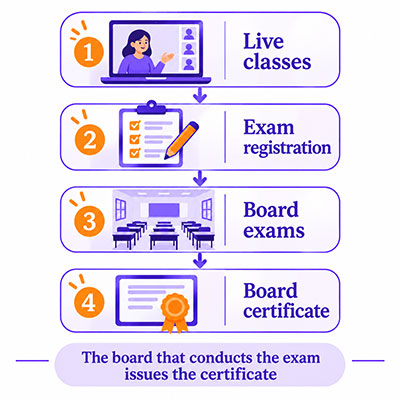
Choosing among recognised virtual schools in India requires parents to look beyond an institution’s website or accreditation claims. In the case of physical schools, the first thing a parent checks is the affiliating board. Schools with a physical building and regular classrooms easily get affiliation from recognised boards like CBSE, ICSE, or State Boards. However, the rules are completely different for online schools.
Here are 3 important factors to look for:
A valid examination board
The school should clearly explain which recognised board will conduct the Class 10 and Class 12 examinations and issue the certificates. In India, the National Institute of Open Schooling (NIOS) is an autonomous institution under the Ministry of Education that conducts Secondary and Senior Secondary examinations. You can learn more about its role and recognition on the official NIOS website.
A clear academic curriculum and structure
Parents should understand whether the school follows a CBSE-aligned curriculum or another academic framework. Remember, following a particular board’s curriculum does not automatically mean that school is affiliated with that board. The curriculum, teaching standards, and examination pathway should be clearly explained before admission.
Verifiable accreditation and institutional credentials
Apart from the board recognition, parents should understand whether the school has undergone an independent quality assessment. Ask for the accreditation certificate, the name of the accrediting organisation, and its validity details.
How to Check an Online School’s Accreditation? Step-by-Step Process
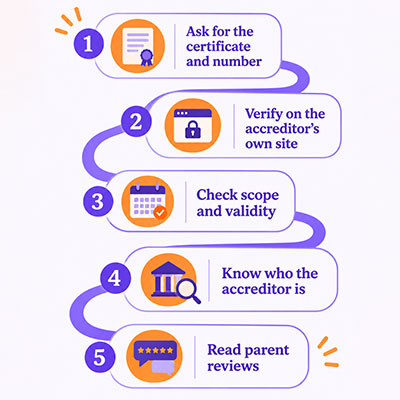
Checking online school accreditation takes less than an hour. Do these checks before you pay any fee.
- Ask for the accreditation certificate and its number. A truly accredited school will share it without any hesitation.
- Verify it on the accrediting body’s own website. Do not rely only on the school page. Look for the school’s name in the accreditor’s directory as well.
- Check the scope and validity. Is the accreditation only for one programme, and till when is it valid?
- Understand what the accreditor is. Find out whether the body is a government authority, an exam board, or a private quality accreditor like the International Accreditation Organisation (IAO). Read what the review covers.
- Read parent reviews. Look beyond the school’s own testimonials.
Questions on Accreditation to Ask Before Admission

Ask for answers to the following questions from the school, in writing, preferably via e-mail. Pay any fees only when you get genuine answers to the below questions.
- Which board will my child’s Class 10 and Class 12 certificates come from?
- Who registers my child for the board exams, and where are they held?
- Who is the accreditor, and what exactly does the accreditation cover?
- Is the school registered, and where?
- What is the transfer certificate policy?
- What is the fee structure and the refund policy?
Red Flags to Watch Out For
- Vague claims such as “internationally recognized” with no named body.
- No certificate or number when you ask for one.
- Claims of CBSE or government affiliation that cannot be verified on the government’s own site.
- Guaranteed marks, ranks, or admissions.
How Cyboard School Approaches Accreditation and Recognition

Accreditation: Cyboard School is accredited by the International Accreditation Organization (IAO). IAO accreditation ensures that Cyboard follows a set of standards and procedures that guarantee high-quality education for students.
Curriculum and Board Exams: The curriculum is aligned to CBSE, and our students’ secondary (Class 10) and senior secondary (Class 12) examinations are conducted through NIOS.
For more details, see the detailed blog on IAO Accreditation and how Cyboard ensures quality education, and read about our curriculum.
Conclusion
Accreditation and board recognition answer two different questions, and a school is only as trustworthy as its answers to both. Accreditation tells you who has reviewed the school’s quality. The examination board tells you whether your child’s Class 10th or Class 12th certificates carry the same importance as CBSE or ICSE. Treat them as separate checks, and never accept one as proof of the other.
A one-week plan to shortlist a school
Days 1-2: Note each school’s accreditor and exam board, and confirm both on their official websites.
Days 3-4: Shortlist the ones that have an accrediting body as well as a valid board certificate pathway.
Day 5: Attend a demo class with your child. Ask about class size, teacher qualifications, and how progress is assessed.
Days 6-7: Check the admission rules of the colleges or entrance exams your child may target. Make sure that the board certificate fits those targets.
Once you enroll, keep copies of the accreditation certificate, board recognition confirmation, and fee receipts. They are the documents that you’ll need if anything is questioned later.