

Let’s rewind to a year ago, the last day of your child’s school.
Your child walks out buzzing, telling you about everything they can’t wait to do in summer camp. New things to learn, new people to meet, new adventures to be had. It was a fantastic plan. But before you knew it, the entire month passed, and they didn’t set foot outside once. Not for lack of choices, but because you and your child were indecisive on what they’d really like to do. And now again you have the entire summer ahead of you, and you’re left with the same question most parents face – How will I keep my child engaged, learning, and busy this summer?
Choosing a summer camp type isn’t as simple a decision as it once was. With the rise of digital education, the online vs offline summer camp debate has become more relevant than ever.
Should you send your child to a local camp to engage in outdoor play and physical activity, or enroll them in an online program to learn a new skill, such as coding, music, or a new language from an expert from around the world?
If you find yourself unable to make this decision, know that you’re not alone.
In this guide, we’ll cover the distinctions, pros, and benefits of both online and offline summer camp, so you can feel more confident when it comes to picking a summer camp type that will work for your child.
What Exactly Is An Online Camp & an Offline Camp?

Many people believe that an online summer camp consists entirely of children watching recorded videos. However, that is not true anymore, as online camps have changed now they are much more interactive than they once were.
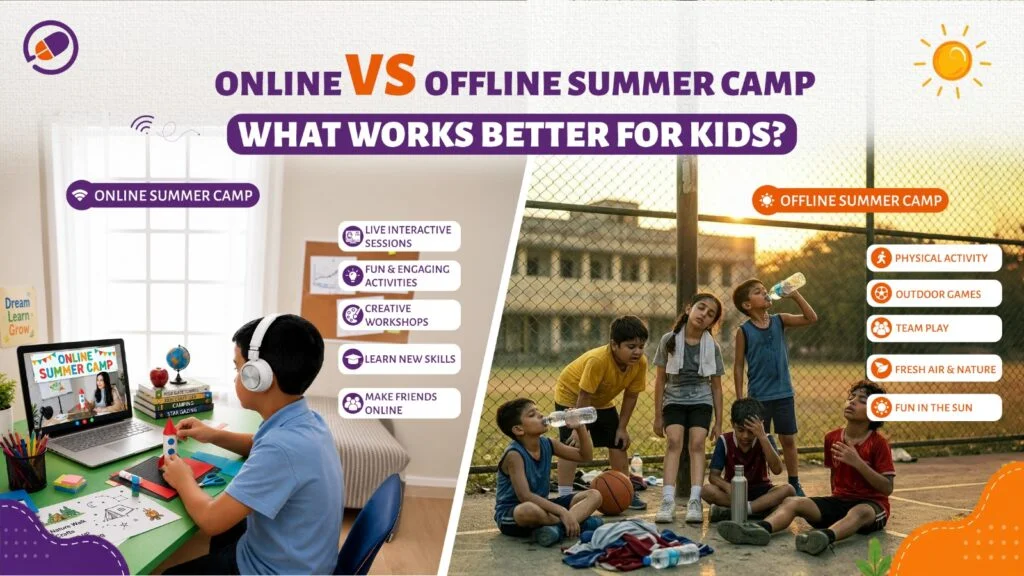
Most of today’s online summer camp activities involve live sessions with teachers and interactive or hands-on activities for kids to participate in. Rather than merely sitting through lectures and viewing videos, children will be able to work together in break-out rooms to solve problems as part of a team, conduct collaborative digital white-board activities where they will be able to build and code creations while developing their creativity, and make connections with other children from different cities and even different countries through online video conferencing.
The entire focus is on the child’s ability to be actively involved, rather than on how many hours per day they sit in front of a computer screen.
On the other hand, offline summer camp programs provide an in-person experience related to outdoor and social activities (sports, art workshops) as well as an opportunity for social interaction with others. The biggest difference between an online vs offline summer camp is not necessarily location, but how the child is learning and being engaged.
The development of online learning summer camps has been impressive, and online summer camps are particularly effective for teaching the more skill-based subjects such as coding, graphic design, animation, creative writing, financial literacy, and advanced mathematics.
Kids who participate in an online summer camp can enjoy gamified, interactive learning experiences with tools and able to receive live feedback while they are building skills in the comfort of their own homes.
Benefits of Online Summer Camp for Modern Families

With today’s hectic lifestyles and increasing demands for specific expertise, the advantages of online summer camp programs are making them a favorite among millions of parents.
Below is a brief look at why such virtual camps are becoming more popular.
1. Incomparable Convenience and Flexibility.
Summer can get pretty busy, from traveling with family, visiting relatives, to parent obligations at work. It can be really hard to organize attendance at physical locations every single day for several weeks. With virtual summer camps, however, there is no commuting involved. No matter whether your kid is at home, grandma’s place, or even the hotel where you happen to be staying during your family vacation, they only need an internet connection to participate. No rushing through the morning traffic to make sure you are on time for your 9:00 am drop-off anymore.
2. Wide Range of Specific Subjects.
Local community centers are definitely helpful in terms of summer activities for kids, however, they are unlikely to employ experts in such specific subjects as artificial intelligence, game designing, or even illustrating anime characters. Virtual summer camp, on the other hand, opens the doors to many specific areas of knowledge.
3. Customized Speed of Learning.
In an offline summer camp with around 20 children, teachers usually manage the class at an average pace, which limits individual attention.
In online camps, technology allows a more personalized approach. provide one-on-one support in chat rooms, and let students learn at their own pace. This makes learning more flexible, focused, and tailored to each child’s needs.
4. Safe Environment.
Parents who are worried about cyberbullying, physical harm from playground activities, and other kinds of dangers will find. online camps much safer for their kids. The online classroom environment takes place right at home, where you will be able to observe the process without your kid even knowing it, and make sure that they eat healthy snacks.
5. Highly Affordable
An offline camp involves various expenses such as facility rentals, liability insurance, materials, and administrative costs. Many of these costs are reduced in online camps. Parents also save on transportation, additional childcare, and extra camp supplies.
Offline Summer Camp Advantages
While online camps offer incredible flexibility and innovation, physical camps still hold their own unique charm.
Physical Activities and Outdoor Play.
Offline camps provide hands-on movement and outdoor experiences, great for kids who thrive in active, open-air environments.
Face-to-Face Social Development
In-person settings offer a different social dynamic, helping kids practice face-to-face interaction and build emotional awareness naturally.
Hands-On, Tactile Experiences
Certain activities like pottery or woodworking carry a tactile quality that feels special in a physical setting, a sensory play experience all its own.
Which is the Best Summer Camp for Your Child?

Deciding on online vs offline summer camp is not about finding the universally “perfect” option, it is about finding what works best for your child and your family dynamics.
Here is a framework to help you decide:
Consider Your Child's Personality
- The Introvert/Deep Thinker: If your child easily gets overwhelmed by loud noises, large crowds, and chaotic environments, an online camp might be a breath of fresh air. They can focus deeply on their interests (like writing or coding) without the social exhaustion of a physical camp.
- The High-Energy Extrovert: If your child bounces off the walls, craves constant physical interaction, and loves being the center of attention in a group, an offline sports or theater camp is likely the better fit to channel that energy.
Consider Their Goals
- Skill Acquisition: Are you looking to give them a head start for the future? If they want to learn Python, build a website, or master a foreign language, online camps provide the best instructors and environment for focused, hard-skill learning.
- General Recreation: If the goal is purely to get them out of the house, burn calories, and try out a bunch of random physical activities, an offline day camp is the way to go.
Consider Parent Constraints
Be realistic about your own schedule. If you are working from home and need your child quietly engaged in an enriching activity for 3 hours every morning, an online camp is a lifesaver. If you work outside the home and require full-day childcare where the kids are physically supervised elsewhere from 8 AM to 5 PM, an offline camp is a logistical necessity.
Discussion on Online Summer Camp

As online education becomes mainstream, a few outdated misconceptions still linger.
Let’s clear up some common myths about virtual summer camps.
Kids don’t stay engaged; they just zone out.
This is only true of poorly designed, lecture-style webinars. Top-tier online summer camps use high-energy instructors, constant interactive polls, screen-sharing, digital rewards, and short, focused project sprints to keep kids entirely hooked.
It's just more unhealthy screen time.
Not all screen time is created equal. There is a massive difference between passive screen time (mindlessly scrolling social media or binge-watching cartoons) and active screen time (writing lines of code, illustrating a digital comic, or conversing in Spanish). Online camps provide active, brain-stimulating screen time that builds lifelong skills.
Online camps are less effective than offline ones.
For specific subjects, online camps are actually more effective. When learning computer science, for example, doing it on the actual device with a teacher who can instantly take over the screen to highlight a bug is far more efficient than learning it in a crowded school computer lab.
Tips for Parents
If you have decided to explore options, keep these tips in mind to ensure you get the best return on your investment and the best experience for your child.
1. Involve Your Child in the Decision
Do not sign your child up without asking them. Explore the course options together. When children get to choose something they truly enjoy, like Minecraft Modding instead of Beginner Chess, they feel more excited and interested in joining the camp.
2. Check the Student-to-Teacher Ratio
Whether online or offline, very large groups can make children feel overlooked. For online camps, especially, smaller group sizes, usually around 4 to 8 students per instructor, work much better because children get more attention, support, and guidance whenever they need help.
3. Verify Instructor Credentials
Who is actually teaching your child? Look for camps that hire experts, college students from top universities majoring in the subject, or certified teachers. A great curriculum falls flat without an enthusiastic, knowledgeable instructor.
4. Review Tech Requirements Early
If you lean toward online camps, double-check the technology requirements before the first day. Does your laptop meet the software specifications? Do you need a separate microphone? Getting this sorted early prevents day-one frustration.
Finding the Perfect Balance for the Summer

The debate of online vs offline summer camp does not have to end with a strict winner. Both formats offer incredible, yet distinct, advantages for your child’s growth. Offline camps remain champions of physical health, traditional social cues, and getting muddy in the great outdoors.
However, online summer camps have undeniably proven themselves as a powerful, modern alternative. They offer unprecedented flexibility for busy parents, cost-effective pricing, and a level of specialized skill-building that local physical camps simply cannot match.
By embracing virtual camps, you are not just keeping your child busy, you are providing them with future-ready skills in a comfortable, safe environment.
Ultimately, the “best” choice depends on your child’s personality, your family’s schedule, and the specific goals you have for their summer vacation.
Ready to turn your child’s screen time into skill time this summer?
Contact us at 9519519521 now to find the perfect online summer camp for your child’s unique passions.
Frequently Asked Questions (FAQs)
1. Can kids really make friends in an online summer camp?
2. Are online camps cheaper than offline ones?
3. What age is appropriate for online learning for kids in summer camps?
4. How do I manage screen time if I choose an online camp?
5. Is a hybrid approach possible?
Explore More on Cyboard School